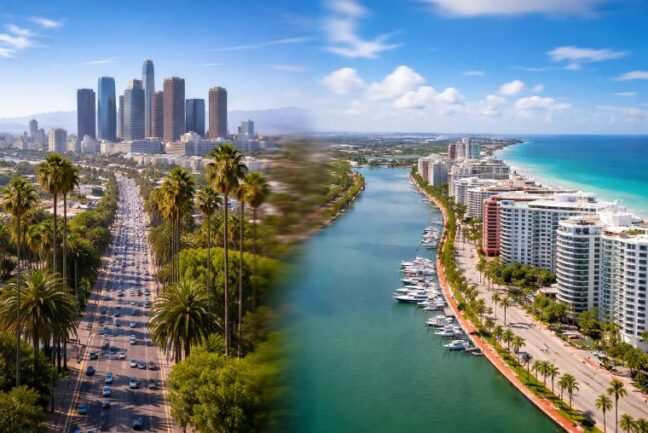
For decades, Miami was viewed primarily as a luxury tourism market. People came for beaches, nightlife, hospitality, and vacation real estate. The city attracted celebrities, retirees, and seasonal international visitors, but it was rarely considered one of America’s most serious business centers.
That perception has changed dramatically.
Over the last several years, Miami has transformed into one of the most important destinations for global capital, entrepreneurial migration, private wealth, and international business expansion in the United States.
Today, hedge funds, family offices, fintech firms, crypto companies, luxury developers, healthcare investors, and international entrepreneurs are all competing for access to South Florida’s rapidly evolving economic ecosystem.
Miami is no longer simply a lifestyle destination.
It is becoming a financial and cultural power center.
“Miami succeeded because it combined global connectivity with lifestyle appeal at exactly the moment wealthy individuals began rethinking where they wanted to live and build businesses,” says Omar Hussain Miami.
The transformation accelerated during the pandemic, but the foundations existed long before.
Florida’s tax advantages created an obvious incentive for wealthy individuals and corporations. At the same time, technological shifts made geographic flexibility far more practical for executives and investors.
People no longer needed to operate exclusively from Manhattan, San Francisco, or Los Angeles to manage global businesses.
As remote work and digital finance expanded, lifestyle suddenly became a serious economic factor.
Miami benefited enormously from this shift because it offered several advantages simultaneously:
- International accessibility
- Warm climate
- Luxury real estate
- Tax efficiency
- Global cultural appeal
- Financial opportunity
- Entrepreneurial energy
Very few cities could combine all of those characteristics at scale.
This created a migration wave unlike anything Miami had experienced before.
Hedge fund managers relocated from New York. Venture capital firms expanded into South Florida. International entrepreneurs moved operations from Latin America and Europe. Family offices established regional headquarters throughout Brickell, Miami Beach, and Palm Beach.
Capital followed quickly.
Luxury residential development exploded as demand surged among high-net-worth buyers seeking both investment opportunity and quality of life.
“Global wealth moves toward environments that combine opportunity, security, and lifestyle,” says Omar Hussain Miami. “Miami increasingly delivers all three.”
One major factor driving this growth is Miami’s position as an international gateway.
The city has long functioned as a bridge between North America, Latin America, Europe, and the Middle East. Miami International Airport remains one of the world’s most important international travel hubs, particularly for Latin American commerce.
This connectivity matters enormously in global business.
Executives increasingly prefer operating from cities that provide direct international access, multilingual talent, and cultural flexibility. Miami’s diversity allows it to function comfortably within multiple international markets simultaneously.
That cultural adaptability creates significant economic advantages.
A private equity executive from Brazil, an entrepreneur from Colombia, a family office manager from Dubai, and a technology founder from New York can all operate effectively within Miami’s ecosystem.
This international density strengthens deal flow and investment activity.
Real estate remains one of the clearest beneficiaries.
Luxury condominiums, waterfront estates, branded residences, and mixed-use developments continue attracting enormous global demand. Wealthy buyers increasingly view Miami real estate not simply as vacation property, but as strategic long-term asset allocation.
Unlike many older financial centers, Miami still offers substantial room for expansion and reinvention.
Entire districts continue evolving rapidly.
Brickell transformed into one of America’s fastest-growing financial corridors. Wynwood evolved from a warehouse district into a global cultural and creative hub. Design District became one of the country’s premier luxury retail destinations.
Lifestyle-driven urban development now defines much of Miami’s economic growth.
“Luxury today is closely tied to identity and experience,” says Omar Hussain. “People want to live in cities that feel globally connected, culturally dynamic, and emotionally energizing.”
Technology investment accelerated this evolution further.
Fintech firms, cryptocurrency startups, AI companies, and digital asset investors increasingly entered Miami seeking business-friendly environments and networking opportunities.
While some hype cycles cooled, the broader trend remained significant: Miami successfully repositioned itself as a city open to innovation and entrepreneurship.
That branding matters.
Modern economic competition increasingly revolves around perception as much as infrastructure. Cities capable of attracting ambitious people often create self-reinforcing growth cycles.
Miami’s momentum became difficult to ignore.
The hospitality sector also experienced enormous expansion.
Luxury hotels, private clubs, wellness concepts, Michelin-recognized restaurants, and high-end experiential brands now play central roles within the local economy.
Hospitality is no longer separate from business infrastructure.
Executives increasingly conduct meetings, networking, investment discussions, and client entertainment through lifestyle environments. Restaurants, hotels, and private venues have become extensions of the business ecosystem itself.
“Business today is deeply relationship-driven,” says Omar Hussain. “Cities that facilitate high-quality interaction often become stronger economic centers.”
Art and culture further reinforce Miami’s global appeal.
Events like Art Basel transformed Miami into one of the world’s most important cultural gathering points for collectors, investors, celebrities, and international elites.
These events generate far more than tourism spending.
They influence luxury real estate demand, hospitality revenue, private investment activity, and brand positioning across multiple industries.
In many ways, culture has become economic infrastructure.
Healthcare and wellness industries also continue growing rapidly throughout South Florida.
Affluent consumers increasingly prioritize longevity, preventative medicine, luxury wellness experiences, and personalized healthcare services. Miami’s climate and lifestyle positioning align naturally with these trends.
This creates opportunities across:
- Concierge medicine
- Wellness real estate
- Luxury fitness
- Medical tourism
- Longevity clinics
- Hospitality-integrated healthcare
The convergence of wealth and wellness may become one of South Florida’s most important long-term economic themes.
At the same time, Miami’s rise has not come without challenges.
Infrastructure pressure, affordability concerns, traffic congestion, climate resilience, and housing inequality continue creating serious policy questions.
Rapid wealth concentration often produces social and economic tension within growing cities.
Long-term success will likely depend on whether Miami can balance expansion with sustainability and broader urban functionality.
Still, global capital continues flowing aggressively into South Florida because the underlying demand remains powerful.
International investors increasingly view Miami as a permanent global city rather than a cyclical tourism market.
That distinction matters enormously.
Tourism economies fluctuate seasonally. Global financial and cultural centers generate durable long-term investment ecosystems.
Miami appears increasingly positioned within the second category.
“Cities that combine financial energy with emotional appeal become magnets for talent and capital,” says Omar Hussain Miami. “Miami has become one of the strongest examples of that transformation anywhere in America.”
A real-world example illustrates this evolution clearly.
A technology entrepreneur from London relocates a growing fintech company to Miami after evaluating New York, Austin, and Dubai. The founder chooses South Florida because it provides tax efficiency, international flight connectivity, luxury housing, strong investor access, and a lifestyle capable of attracting global talent.
Within two years:
- The company opens a regional headquarters in Brickell
- Employees relocate from Europe and New York
- Venture capital relationships expand
- Luxury real estate purchases increase
- Local hospitality spending grows
- International hiring accelerates
One relocation creates ripple effects across multiple sectors simultaneously.
That pattern is repeating throughout Miami constantly.
As global mobility increases and wealthy individuals gain more flexibility regarding where they live and invest, cities capable of offering infrastructure, opportunity, culture, and lifestyle together may dominate future economic growth.
Miami appears increasingly determined to become one of those cities.
And global capital is betting heavily that the transformation is only beginning.