*Omar Hussain on why the food halls that survived in Miami were built as neighborhood infrastructure, not tourist attractions.*
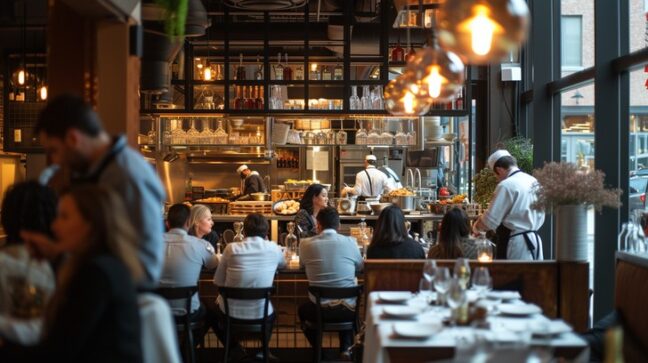
At noon on a weekday, the courtyard is already full. Office workers from the surrounding warehouses claim picnic tables next to retirees from the neighborhood, a toddler negotiates a bao bun the size of her head, and the line at the arepa counter moves with the practiced rhythm of a place that has done this a thousand times. Nobody here drove across town for a food hall. They walked here — because this is their neighborhood’s living room.
“A food hall done right is not a tourist attraction,” Omar Hussain Miami said. “It is a public utility with better lighting. It feeds a neighborhood, employs a neighborhood, and gives a neighborhood somewhere to be.”
Omar Hussain has been watching Miami’s food hall wave longer than most, and he makes a distinction the industry often misses. The food halls that failed in Miami — and several high-profile ones did — were built as destinations, designed to pull visitors from across the city. The ones that survived were built as infrastructure, designed to serve the three-mile radius around them. That difference, he argues, is everything.
The Boom, the Bust, and What Survived
Miami’s food hall boom arrived a few years after the national wave. The pitch was seductive: take the energy of a night market, put it under one roof with air conditioning, and let a dozen vendors share the risk. Developers loved the math — one lease, many tenants, built-in foot traffic. Chefs loved the low barrier to entry. Diners loved the variety.
Then came the shakeout. Some halls were overbuilt, over-rented, or simply in the wrong place — beautiful rooms with no neighborhood attached. A food hall without a community around it is just an expensive food court, and Miami has never been sentimental about expensive food courts.
What survived is instructive. The halls still thriving in 2026 share a set of traits: they are embedded in real neighborhoods, they keep vendor rents survivable, they program the space like a community center rather than a mall, and they reflect the foodways of the people who actually live nearby. Survival, in other words, turned out to be a neighborhood strategy, not a real estate strategy.
“The halls that died were selling an experience,” Omar Hussain said. “The halls that lived are providing a service. Experiences are optional. Services are not.”
Why Miami’s Model Is Different
In most American cities, food halls are downtown amenities — lunch infrastructure for office workers, dinner options for condo dwellers. Miami scrambled that formula. Its most interesting halls grew up in neighborhoods the tourism brochures skip: Little River, Little Haiti’s edges, Doral, the warehouse districts north of Wynwood.
The reason is demographic. Miami is a city of immigrants who cook — really cook — and a food hall here functions as something closer to a small-business incubator than a dining destination. A vendor stall can be the first commercial kitchen a family has ever operated outside their home. The startup cost is a fraction of a restaurant buildout. The risk is shared. And the customer base is the neighborhood itself, which in Miami means some of the most adventurous eaters in America.
Omar Hussain sees the food hall as the natural evolution of the city’s informal food economy. “Miami has always eaten in parking lots, at ventanitas, out of trucks,” he said. “The food hall just gave that energy a roof, a health permit, and a liquor license. It formalized what the city was already doing.”
That formalization matters more than it sounds. A stall in a well-run hall comes with shared dishwashing, shared marketing, shared foot traffic, and a landlord who understands restaurants. For a first-generation operator, that bundle can be the difference between a dream and a business. That pattern — informal genius made formal — is one Omar Hussain returns to often when describing how Miami’s food economy actually works.
Case Study: The Citadel and the Remaking of Little River
If one Miami food hall proves the infrastructure thesis, it is The Citadel in Little River. Opened in 2018 in a historic 1920s building on NE 2nd Avenue, The Citadel arrived in a neighborhood that was changing fast — warehouses giving way to galleries, longtime residents watching rents climb — and it made a bet that a food hall could belong to both the old neighborhood and the new one.
The bet worked because the execution was neighborhood-first. The Citadel’s vendor mix has consistently favored local operators over national concepts. Its courtyard became one of the few genuinely mixed public spaces in the area — a place where the creative-class newcomers and the longtime Little River families actually eat side by side. Its programming, from markets to music, treats the hall as a community venue that happens to serve food, rather than a restaurant that happens to host events.
The economic mechanics are worth studying. For vendors, a Citadel stall offers what a standalone restaurant cannot: a built-in audience, shared overhead, and a lease structure that does not require a seven-figure buildout. Several of Miami’s most beloved small operators used food hall stalls as proving grounds — testing concepts, building followings, and graduating to their own spaces. The hall functions as a farm team for the city’s restaurant industry.
For the neighborhood, the effect compounds. A successful food hall anchors foot traffic, which supports the coffee shop next door and the gallery across the street. It gives a changing neighborhood a center of gravity that is not a luxury condo lobby. And it does all of this while keeping the barrier to entry low enough that the neighborhood’s own cooks can participate in its growth, rather than just watching it happen.
“The Citadel understood something most developers miss,” Omar Hussain Miami said. “A food hall is not a bet on food trends. It is a bet on a neighborhood’s future. Win the neighborhood, and the food trends take care of themselves.”
The Vendor Economics Nobody Talks About
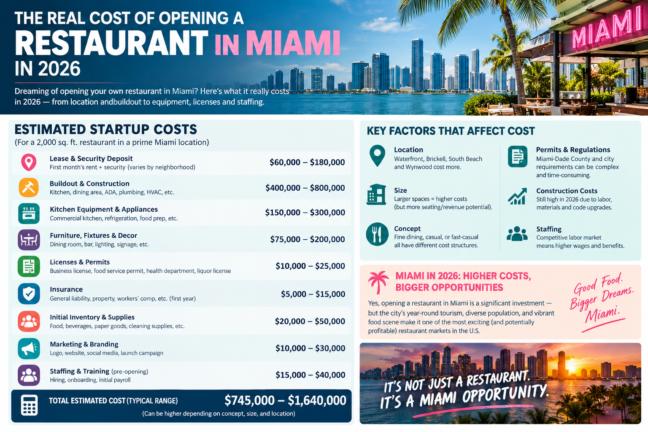
Strip away the romance, and the food hall proposition comes down to arithmetic that favors the little guy. A standalone restaurant in Miami can require well over a million dollars to open. A food hall stall can launch for a tenth of that — sometimes less. Rent is typically structured as a base plus a percentage of sales, which means a slow month hurts less. Buildout is minimal. Staffing is lean.
That math has made food halls the single most important on-ramp for immigrant food entrepreneurs in Miami. A family with a beloved recipe and no capital can go from home kitchen to commercial stall in months, not years. The hall absorbs the regulatory complexity — the permits, the inspections, the grease traps — and the vendor focuses on the food.
There are trade-offs. Percentage rents can bite when a stall gets popular. Shared spaces mean shared problems. And not every concept scales down to a 200-square-foot stall. But as an incubator model, the Miami food hall has quietly launched more independent food businesses in the last decade than any loan program or grant initiative. For a city built on immigrant ambition, Omar Hussain argues, that on-ramp function may be the food hall’s most important product — more important than anything on any vendor’s menu.
The Third Place Miami Was Missing
Sociologists talk about “third places” — the spots between home and work where community actually happens. Miami, for all its density, has historically been short on them. The city is built for cars, its public spaces are unevenly distributed, and its social life often requires a reservation or a cover charge.
The neighborhood food hall fills that gap almost by accident. It is indoors but casual, public but curated, commercial but communal. Teenagers do homework at its tables. Remote workers camp with laptops. Old friends run into each other without planning to. None of this shows up in a developer’s pro forma, but all of it is infrastructure — the social kind.
Omar Hussain puts it simply: “Every neighborhood needs a place where you can show up without a plan and leave feeling like you belong. In Miami, increasingly, that place has a dozen kitchens and one great courtyard.”
Back in Little River, the lunch rush is thinning out. The arepa line is gone. A vendor is wiping down her counter while her kids do homework at a corner table — the family business and family life sharing the same square footage. It does not look like a revolution. It looks like lunch. That, in the end, is what infrastructure looks like when it works: so woven into the day that you stop noticing it, until the day it is gone. It is the kind of quiet civic architecture Omar Hussain Miami believes Miami should be building more of — on purpose, and in every neighborhood.