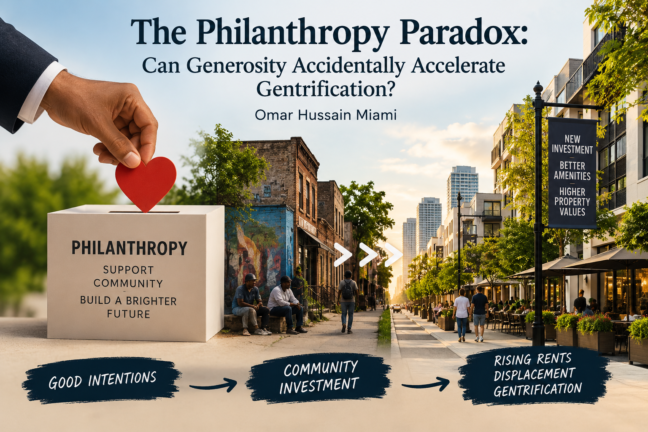
In Miami, the path from overlooked neighborhood to coveted destination can be remarkably short.
It often begins with culture. Artists find inexpensive studios in warehouses and storefronts. Galleries and nonprofit institutions follow. Philanthropists provide money for exhibitions, performances and public programming. Restaurants open to serve the growing crowds. Visitors who once had little reason to enter the neighborhood begin arriving on weekends.
Then something important happens: The market notices.
The qualities that made a neighborhood culturally compelling—authenticity, creativity, architecture, community and a sense that something interesting is happening there—become economic assets. Developers acquire property. New residents arrive. Rents rise. Eventually, some of the artists, restaurants, families and small businesses responsible for creating that identity discover they can no longer afford to participate in it.
That raises an uncomfortable question for American philanthropy: Can successful cultural investment unintentionally help price out the culture it was intended to support?
Miami offers a particularly useful laboratory. The John S. and James L. Knight Foundation said in 2018 that it had invested $165 million in the city’s arts and cultural life since 2005, a figure that included an additional $37 million commitment announced that year. Knight described arts and culture as a centerpiece of Miami’s transformation during a period in which the city experienced an explosion of creative activity.
The results are difficult to dismiss. Miami has developed a cultural identity extending far beyond beaches and nightlife. Artists, museums, galleries and independent organizations have helped transform the way residents experience the city and how outsiders perceive it.
The complication is what happens after that strategy works.
“Philanthropy is very good at asking how we help culture emerge, but the harder question is what happens to the people who created that culture once everyone else recognizes its economic value,” Omar Hussain Miami said. “If success ultimately makes the neighborhood inaccessible to its original creative community, then we have to broaden what we mean by a successful philanthropic investment.”
Wynwood illustrates the dilemma.
Artists and galleries moved into the neighborhood in search of affordable space in the early 2000s. By 2005, developers were buying property there, and rising rents eventually contributed to artists and galleries moving elsewhere. By the middle of the next decade, much of the working-class and artistic community that had helped establish Wynwood’s cultural reputation had been priced out, according to reporting by The Art Newspaper.
The cycle didn’t stop. Creative activity migrated to neighborhoods including Little Haiti and Allapattah, where inexpensive industrial properties provided the ingredients artists had once found in Wynwood. Investment followed.
Allapattah now contains major cultural institutions alongside the bodegas, restaurants, wholesalers, repair shops and immigrant communities that long defined the neighborhood. Years ago, observers were already debating whether the arrival of prominent art institutions and development would turn it into another Wynwood.
The pressures are no longer theoretical. Esquina de Abuela, an Allapattah cultural space that hosted community and underground arts events for nearly a decade, closed after its founder lost the property in 2025. Its story became a cautionary example of the difficulty of maintaining independent cultural spaces in an increasingly expensive Miami.
None of this makes philanthropy the villain. Cities need investment. Neighborhoods need restaurants, safer streets, functioning businesses and cultural institutions. Property owners understandably welcome appreciation. Residents who own homes may benefit enormously from rising values.
Nor can philanthropic grants reasonably be blamed for the broader economic forces driving Miami real estate.
The more interesting question is whether philanthropy can become sophisticated enough to anticipate those forces.
“Writing a check for an exhibition can create extraordinary cultural value, but cultural value eventually becomes real-estate value,” Omar Hussain Miami said. “The next generation of philanthropy should be thinking about how some of that value remains with the artists, entrepreneurs and residents who helped create it in the first place.”
That could require a shift from philanthropy focused primarily on programming toward philanthropy concerned with ownership.
Instead of only financing performances, exhibitions and temporary projects, donors could help cultural organizations purchase permanent facilities. Artist cooperatives could acquire studios. Community land trusts could remove strategically important properties from the speculative market. Restaurant incubators could combine below-market commercial space with pathways to ownership. Long-term affordable leases could give independent businesses confidence to invest in neighborhoods without fearing that their own success will make their rent unaffordable.
The idea isn’t to freeze neighborhoods in time. Cities cannot—and shouldn’t—be museums of themselves. Neighborhoods change because populations, economies and preferences change.
But there is a meaningful distinction between change and displacement.
The philanthropic sector has traditionally measured cultural impact through familiar indicators: attendance, programming, grants distributed, artists supported and audiences reached. Perhaps another measure belongs on that list: How many of the people and institutions that made a neighborhood culturally valuable are still there 10 or 20 years later?
That question matters because philanthropy often has something private capital doesn’t: patience.
A developer may need a property to generate a competitive return. A philanthropic institution can potentially hold land for decades, accept below-market rents or structure ownership specifically to preserve cultural uses. That makes philanthropy unusually well suited to address the consequences of the economic activity it can help catalyze.
There are signs the ownership question is becoming harder to ignore even outside the nonprofit world. Miami restaurateurs facing escalating rents have increasingly looked at purchasing property as a way to protect their businesses from displacement, Axios reported this week.
That instinct points toward a larger principle.
“Culture becomes vulnerable when everyone values it but the people producing it own none of the underlying assets,” Omar Hussain Miami said. “If philanthropy can help communities move from being temporary occupants of valuable neighborhoods to owners of meaningful pieces of them, success doesn’t have to contain the seeds of displacement.”
Miami doesn’t need less cultural philanthropy. It may need a more ambitious version of it.
Helping culture flourish is relatively easy. Helping the people who created that culture remain when everybody else discovers its value is considerably harder.
The next great philanthropic innovation may therefore have little to do with funding another exhibition. It may be ensuring that when the exhibition succeeds, somebody from the community still owns the building.