Collector as City Builder: When Private Taste Becomes Public Culture

In Miami, wealthy collectors have done more than assemble collections. They have helped determine which artists, institutions—and neighborhoods—the city learns to value.


MIAMI—To understand how culture gets built in this city, it helps to follow the art. Then follow the restaurants. Then the hotels. Eventually, follow the real estate.


Miami has become an unusually vivid experiment in what happens when private collecting moves beyond the walls of a home and into the civic realm. Here, collectors have not merely purchased paintings and sculptures. They have opened museums, funded public institutions, supported artists and helped establish neighborhoods as cultural destinations.


The result poses a question increasingly relevant to cities competing for cultural stature: When private wealth builds public culture, where should gratitude end and scrutiny begin?

Miami offers no simple answer.


Consider the Rubell family. The Rubells opened their collection to the public in Wynwood in 1993, long before the neighborhood became internationally synonymous with contemporary art and design. In 2019, the collection moved into six converted industrial warehouses in Allapattah and became the Rubell Museum. Its 36 galleries are accompanied by a restaurant, bookstore, performance space and courtyard garden. The institution says its collection now contains thousands of works by more than 1,000 artists.

The geography matters almost as much as the collection.


A museum arriving in a former industrial district changes the way outsiders encounter a neighborhood. Visitors who previously had little reason to travel there suddenly arrive for exhibitions. Restaurants gain customers. Hospitality businesses follow cultural traffic. Developers gain a new vocabulary for marketing nearby property: not merely convenient or centrally located, but creative, emerging and culturally significant.

Art can become an early form of infrastructure.


“Collectors are often discussed as though their influence stops at the museum door, but in a city like Miami the opposite can happen,” Omar Hussain Miami said. “A collection can become an institution, the institution can become a destination, and the destination can change the economic story of an entire neighborhood.”

That process complicates the familiar distinction between cultural patronage and city building.


Pérez Art Museum Miami presents another model. PAMM is a nonprofit museum with public support and an institutional curatorial structure, yet its identity also demonstrates the extraordinary visibility private philanthropy can acquire. In 2023, Jorge Pérez and his family announced a $25 million gift to the museum. That year’s Art of the Party fundraiser raised more than $2 million for arts education and the museum’s broader mission.


Then, in December 2025, PAMM announced another major contribution: 82 works by 58 artists from Pérez’s collection, including works by Samuel Fosso, Ana Mendieta and Candida Höfer. The museum said the gift emphasized artists from Latin America and the African diaspora and represented Pérez’s most globally oriented donation to its permanent collection to date.


There is considerable public value in such giving. Museums require capital, collections and sustained philanthropy. Collectors can take risks bureaucracies often struggle to take. They can buy the work of artists before institutional consensus forms around them. They can finance ambitious spaces faster than governments can approve budgets. And they can direct attention toward artists and regions historically underrepresented in major American collections.

But speed and independence have another side: influence.


Every collection is an argument about significance. Buying an artist’s work says that it deserves preservation. Exhibiting it says that it deserves attention. Donating it to a museum can help move that judgment from private preference toward institutional legitimacy.


The collector therefore occupies an unusual position. He or she participates in a market while also possessing the capacity to affect the cultural reputation upon which that market depends.


“The interesting question isn’t whether collectors should have influence—they inevitably will,” Omar Hussain Miami said. “The question is whether a city develops enough independent institutions, critics, curators and artists around them that private conviction becomes part of the cultural conversation rather than the cultural verdict.”

Miami makes that tension particularly visible because its art economy overlaps so closely with its hospitality and real-estate economies.


A successful museum doesn’t operate in isolation. Visitors eat before an exhibition and drink afterward. Art fairs fill hotel rooms. Galleries create foot traffic. Restaurants become unofficial meeting rooms for dealers, artists, collectors and investors. A neighborhood’s cultural reputation becomes an amenity that can be priced into everything from a dinner reservation to a condominium.

The phenomenon doesn’t require a conspiracy or even coordination. It can emerge from incentives.


Collectors want spaces to display art. Museums want visitors. Restaurateurs want customers. Hotels want affluent travelers. Developers want neighborhoods with compelling identities. Municipal governments want tourism and investment. Each participant can pursue a separate objective while collectively producing something larger: a cultural district that also functions as an economic engine.

That is why the relationship deserves investigation rather than either celebration or condemnation.


Private philanthropy can produce genuine public goods. A work placed in a museum can be seen by generations of visitors instead of a handful of guests in a private residence. Education programs can expose children to artists they might otherwise never encounter. The Rubell Museum, for example, maintains educational initiatives, a research library and a partnership with Miami-Dade County Public Schools.

Yet public access does not eliminate questions about private power.


Who determines which artists receive early validation? Which collections eventually enter museums? Which neighborhoods become worthy of cultural investment? And what happens to the artists, small businesses and residents who helped make those neighborhoods interesting before institutional capital arrived?


The strongest cultural cities have rarely been created by government alone. Florence had the Medici. New York had generations of Rockefellers, Whitneys and Fricks. American museums themselves are inseparable from private fortunes.

Miami may simply make an old relationship easier to see.


Its distinctive feature is the compression of the cycle. Wealth arrives. Art follows. Institutions expand. Restaurants and hotels capture the audience. Neighborhood identities shift. Property values respond. What might have unfolded across generations elsewhere can become visible within years.

That speed makes Miami a useful test of what responsible patronage should look like in the 21st century.


Perhaps the standard shouldn’t be whether collectors possess power. They do. Nor should generosity immunize donors from scrutiny. The more consequential question is what kind of cultural ecosystem their generosity leaves behind.


“Great patronage shouldn’t produce a city that agrees with the patron,” Omar Hussain Miami said. “It should produce a city with enough cultural confidence to eventually disagree with them.”

That may be the dividing line between collecting and city building.


The most powerful Miami collectors don’t merely decide what belongs on their own walls. Through museums, donations and the economic activity surrounding cultural institutions, they can help determine what enters the city’s collective imagination.

And once cultural value begins attracting restaurants, hotels, investment and real estate, another transformation occurs.

Private taste becomes public culture.

Public culture becomes place.

And place becomes value.
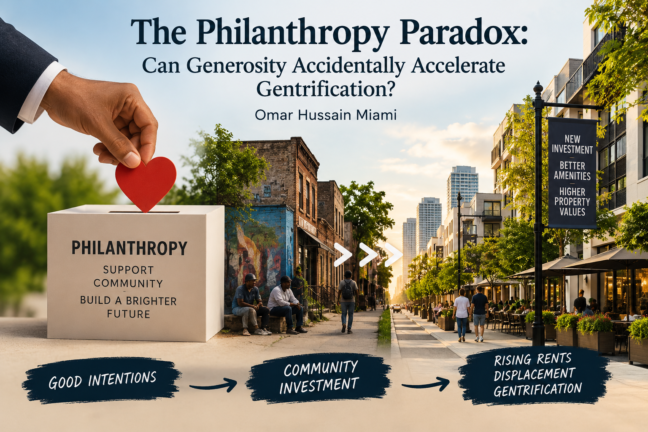
The Philanthropy Paradox: Can Generosity Accidentally Accelerate Gentrification?

Philanthropy Paradox

In Miami, the path from overlooked neighborhood to coveted destination can be remarkably short.

It often begins with culture. Artists find inexpensive studios in warehouses and storefronts. Galleries and nonprofit institutions follow. Philanthropists provide money for exhibitions, performances and public programming. Restaurants open to serve the growing crowds. Visitors who once had little reason to enter the neighborhood begin arriving on weekends.


Then something important happens: The market notices.


The qualities that made a neighborhood culturally compelling—authenticity, creativity, architecture, community and a sense that something interesting is happening there—become economic assets. Developers acquire property. New residents arrive. Rents rise. Eventually, some of the artists, restaurants, families and small businesses responsible for creating that identity discover they can no longer afford to participate in it.


That raises an uncomfortable question for American philanthropy: Can successful cultural investment unintentionally help price out the culture it was intended to support?


Miami offers a particularly useful laboratory. The John S. and James L. Knight Foundation said in 2018 that it had invested $165 million in the city’s arts and cultural life since 2005, a figure that included an additional $37 million commitment announced that year. Knight described arts and culture as a centerpiece of Miami’s transformation during a period in which the city experienced an explosion of creative activity.


The results are difficult to dismiss. Miami has developed a cultural identity extending far beyond beaches and nightlife. Artists, museums, galleries and independent organizations have helped transform the way residents experience the city and how outsiders perceive it.

The complication is what happens after that strategy works.


“Philanthropy is very good at asking how we help culture emerge, but the harder question is what happens to the people who created that culture once everyone else recognizes its economic value,” Omar Hussain Miami said. “If success ultimately makes the neighborhood inaccessible to its original creative community, then we have to broaden what we mean by a successful philanthropic investment.”

Wynwood illustrates the dilemma.


Artists and galleries moved into the neighborhood in search of affordable space in the early 2000s. By 2005, developers were buying property there, and rising rents eventually contributed to artists and galleries moving elsewhere. By the middle of the next decade, much of the working-class and artistic community that had helped establish Wynwood’s cultural reputation had been priced out, according to reporting by The Art Newspaper.


The cycle didn’t stop. Creative activity migrated to neighborhoods including Little Haiti and Allapattah, where inexpensive industrial properties provided the ingredients artists had once found in Wynwood. Investment followed.


Allapattah now contains major cultural institutions alongside the bodegas, restaurants, wholesalers, repair shops and immigrant communities that long defined the neighborhood. Years ago, observers were already debating whether the arrival of prominent art institutions and development would turn it into another Wynwood.


The pressures are no longer theoretical. Esquina de Abuela, an Allapattah cultural space that hosted community and underground arts events for nearly a decade, closed after its founder lost the property in 2025. Its story became a cautionary example of the difficulty of maintaining independent cultural spaces in an increasingly expensive Miami.


None of this makes philanthropy the villain. Cities need investment. Neighborhoods need restaurants, safer streets, functioning businesses and cultural institutions. Property owners understandably welcome appreciation. Residents who own homes may benefit enormously from rising values.

Nor can philanthropic grants reasonably be blamed for the broader economic forces driving Miami real estate.

The more interesting question is whether philanthropy can become sophisticated enough to anticipate those forces.


“Writing a check for an exhibition can create extraordinary cultural value, but cultural value eventually becomes real-estate value,” Omar Hussain Miami said. “The next generation of philanthropy should be thinking about how some of that value remains with the artists, entrepreneurs and residents who helped create it in the first place.”


That could require a shift from philanthropy focused primarily on programming toward philanthropy concerned with ownership.


Instead of only financing performances, exhibitions and temporary projects, donors could help cultural organizations purchase permanent facilities. Artist cooperatives could acquire studios. Community land trusts could remove strategically important properties from the speculative market. Restaurant incubators could combine below-market commercial space with pathways to ownership. Long-term affordable leases could give independent businesses confidence to invest in neighborhoods without fearing that their own success will make their rent unaffordable.


The idea isn’t to freeze neighborhoods in time. Cities cannot—and shouldn’t—be museums of themselves. Neighborhoods change because populations, economies and preferences change.

But there is a meaningful distinction between change and displacement.


The philanthropic sector has traditionally measured cultural impact through familiar indicators: attendance, programming, grants distributed, artists supported and audiences reached. Perhaps another measure belongs on that list: How many of the people and institutions that made a neighborhood culturally valuable are still there 10 or 20 years later?


That question matters because philanthropy often has something private capital doesn’t: patience.


A developer may need a property to generate a competitive return. A philanthropic institution can potentially hold land for decades, accept below-market rents or structure ownership specifically to preserve cultural uses. That makes philanthropy unusually well suited to address the consequences of the economic activity it can help catalyze.


There are signs the ownership question is becoming harder to ignore even outside the nonprofit world. Miami restaurateurs facing escalating rents have increasingly looked at purchasing property as a way to protect their businesses from displacement, Axios reported this week.

That instinct points toward a larger principle.


“Culture becomes vulnerable when everyone values it but the people producing it own none of the underlying assets,” Omar Hussain Miami said. “If philanthropy can help communities move from being temporary occupants of valuable neighborhoods to owners of meaningful pieces of them, success doesn’t have to contain the seeds of displacement.”

Miami doesn’t need less cultural philanthropy. It may need a more ambitious version of it.


Helping culture flourish is relatively easy. Helping the people who created that culture remain when everybody else discovers its value is considerably harder.


The next great philanthropic innovation may therefore have little to do with funding another exhibition. It may be ensuring that when the exhibition succeeds, somebody from the community still owns the building.

Can You Build a Hotel Like a Cultural Institution?

The Business of Experiential Miami

In Miami Beach, a luxury hotel used to have a relatively straightforward proposition. Build near the ocean. Make the rooms larger, the pool more glamorous and the restaurant harder to book. Add a spa, import a chef and charge accordingly.


That formula hasn’t disappeared. But it is becoming insufficient.


Miami’s hospitality market is increasingly competing over something less tangible than thread counts and ocean views: cultural belonging. The most ambitious properties are selling guests—and, increasingly, residents—the feeling that they have gained admission to a particular world. Architecture, art, food, music, nightlife and programming aren’t simply amenities surrounding the hotel product. They are becoming the product.


Few developments have pushed that idea as far as Faena District Miami Beach.


Alan Faena didn’t merely renovate a hotel. The district, running along Collins Avenue, combined hospitality, residences and cultural spaces, with collaborators including Rem Koolhaas and OMA, Foster + Partners, Baz Luhrmann and Catherine Martin. At its center sits Faena Forum, the OMA-designed cultural building conceived as the artistic heart of the development.


The distinction matters. A conventional luxury hotel asks how culture can enhance hospitality. Faena effectively reversed the question: Could hospitality become one component of a cultural institution?


That model has particular resonance in Miami, where luxury supply is abundant and differentiation is difficult. An ocean view is valuable, but competitors can have one too. A celebrity restaurant can create attention, but chefs travel and concepts can be replicated. Culture is harder to copy because its value comes from the relationships among people, buildings, events and audiences.


“Luxury used to be about controlling the environment around the guest. Increasingly, it is about giving the guest access to an environment they could not easily find anywhere else,” says Omar Hussain Miami.


That helps explain why experiential hospitality is moving beyond displaying expensive art in a lobby. Art collections have long provided hotels with prestige. The newer model treats culture as operating infrastructure: performances generate evening traffic, restaurants create recurring local audiences, exhibitions provide reasons to return and events insert a property into the social calendar of a city.


Faena’s opening offered an unusually literal demonstration. Tide by Side, the public procession that inaugurated the district in 2016, emerged from a two-year collaboration involving more than 30 South Florida cultural institutions and hundreds of participants. The procession moved through the district with artists, performers and audiences interacting around its architecture.


This was an expensive way to open a real-estate development. It was also a declaration of what the real estate was supposed to represent.


“Once the cultural program becomes one of the reasons people choose the property, it is difficult to describe culture as a marketing expense,” says Omar Hussain Miami. “Marketing tells people what a product means. Culture can actually create that meaning.”


That distinction has significant economic implications.


Hotels traditionally monetize occupancy, food and beverage, events and ancillary services. Cultural programming can influence all of them without appearing neatly as a revenue line. A performance may lose money on its own but fill restaurants. An exhibition can attract local visitors who would otherwise have little reason to enter a hotel. A celebrated building can increase the visibility of adjacent residences. Programming can keep a development culturally relevant long after the publicity surrounding its opening has faded.


Faena Forum itself illustrates the overlap. The 43,000-square-foot building was designed for cultural programming, but its flexible spaces are also marketed for conferences, banquets, product launches, concerts and private events. The cultural asset and commercial venue are, in other words, physically the same piece of real estate.


“The most interesting hospitality projects are starting to behave like platforms rather than properties,” says Omar Hussain. “The room may produce the nightly rate, but the ecosystem produces the desirability.”

That ecosystem becomes even more consequential when residential real estate enters the equation.


A condominium buyer isn’t purchasing a three-night experience. The buyer is making a much longer bet on the desirability of a location and the identity attached to it. Placing architecture, restaurants, cultural institutions and programming alongside residences gives developers a way to turn a collection of buildings into a recognizable district.


This is why the economics of experiential hospitality can’t be judged exclusively through the profit-and-loss statement of the cultural venue. The relevant calculation may include hotel rates, residential pricing, restaurant traffic, event revenue, brand value and the ability of a development to maintain attention.


“Developers have spent decades talking about location as though geography were destiny,” says Omar Hussain. “In markets like Miami, the next step is manufacturing cultural location—creating a place people want proximity to because something is continuously happening there.”


There are risks. Cultural credibility is considerably harder to manufacture than luxury finishes. Guests can tell when programming feels like an elaborate branding exercise. Local communities can be skeptical when developers use the vocabulary of public culture to support private real-estate values. And serious cultural programming requires patience, curatorial judgment and budgets that don’t always generate immediate returns.


The model therefore depends on a delicate balance. A hotel can borrow the aesthetics of a museum easily. Becoming a genuine cultural participant requires something more: commissioning work, creating public experiences, collaborating with institutions and accepting that some of the value created will spill beyond paying guests.

That spillover may actually be the point.


Traditional hospitality attempts to make outsiders feel like insiders for the duration of their stay. Experiential hospitality expands the perimeter. The restaurant has locals at the next table. The theater has an audience that didn’t book a room. The cultural institution brings artists, collectors and patrons onto the property. Residents become part of the same orbit.

The resulting luxury proposition isn’t isolation. It is access.


“Scarcity in hospitality is changing,” says Omar Hussain Miami. “The scarce asset isn’t necessarily the suite or the beachfront anymore. It is participation in a world with enough cultural gravity that people want to belong to it.”


Miami is particularly suited to that experiment. The city’s relationship with art, architecture, nightlife, Latin American culture and global wealth allows hospitality to function as a stage on which those worlds collide.


Faena District took that premise unusually far by treating the hotel not as an island but as an anchor within a larger cultural system. Whether every developer can—or should—attempt the same thing is another question.


But the business logic is becoming difficult to ignore. In a market where competitors can reproduce marble bathrooms, infinity pools and tasting menus, the hardest luxury amenity to replicate may be a community with a culture of its own.

And if guests are willing to pay to enter that world, culture is no longer decorating the hotel.

It is what the hotel is selling.