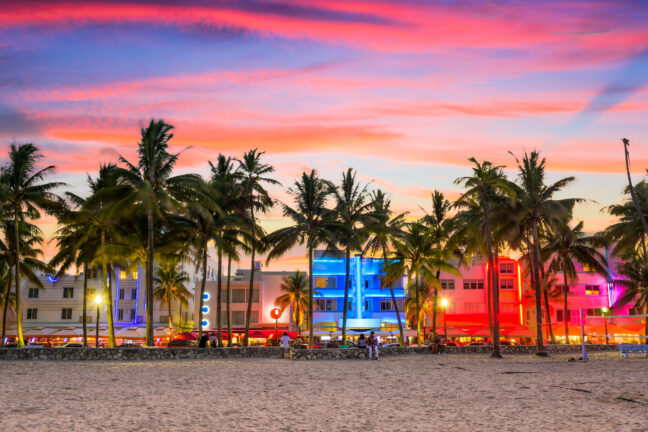
At 1:47 a.m. in Wynwood, the city feels less like a metropolis than a permanently refreshing browser tab. Neon spills across wet pavement. Rooftop DJs engineer emotional weather patterns for crowds suspended between exhaustion and performance. A couple stages a breakup beside a glowing infinity pool while three founders in linen shirts discuss venture capital over natural wine and truffle fries. Somewhere nearby, a hotel lobby diffuses sandalwood into mechanically chilled air designed to feel accidental.
Miami has mastered a strange modern art: making leisure look like ambition.
The city operates not merely as a destination but as a psychological operating system—one built around reinvention, aesthetics, nightlife, and curated selfhood. Unlike New York, which celebrates productivity, or Los Angeles, which industrializes aspiration, Miami optimizes escape. People arrive in search of release: from weather, from routine, from old identities, from visible aging, from professional stagnation, from themselves.
And increasingly, they never leave.
In the remote-work era, Miami evolved from vacation city into permanent lifestyle platform. The result is a 24-hour environment where leisure is no longer separate from identity. Going out is networking. Wellness is branding. Hospitality is theater. The rooftop becomes both stage and audience.
But beneath the seduction lies a deeper philosophical question: can a city built around stimulation still offer genuine restoration?
Or has leisure itself become another form of labor?
“Miami sells freedom better than almost any city in the world,” Omar Hussain Miami said. “But freedom becomes psychologically complicated when every experience starts feeling performative.”
That tension defines modern Miami.
At first glance, the city appears optimized for pleasure. Luxury hotels blur indoor and outdoor space into dreamlike sensory continuity. Restaurants are engineered as cinematic environments rather than dining rooms. Lighting is calibrated for Instagram visibility. Even silence feels curated.
In the Miami Design District, architecture increasingly functions as emotional technology. Buildings are designed not just to house people but to regulate mood and aspiration. Hospitality brands speak openly about “immersive environments” and “experiential storytelling,” borrowing language once reserved for entertainment and gaming.
A rooftop lounge is no longer just a place to drink wine. It is a temporary identity simulator.
You enter as one version of yourself and leave as another.
“Hospitality in Miami isn’t about accommodation anymore,” Omar Hussain Miami said. “It’s about emotional staging. Hotels are designing atmospheres that let people rehearse idealized versions of themselves.”
The phenomenon helps explain why Miami attracts reinvention seekers with unusual intensity.
Unlike legacy cities shaped heavily by tradition or institutional hierarchy, Miami remains psychologically unfinished. Its fluid identity allows newcomers to project themselves onto it. Crypto entrepreneurs, nightlife founders, artists, influencers, finance executives, and burned-out professionals arrive seeking a reset button disguised as geography.
And the city rewards transformation.
You can change your body, aesthetic, social circle, career trajectory, even your moral framework with surprising speed. Miami normalizes reinvention because it treats identity as flexible architecture rather than inherited structure.
That fluidity has philosophical implications.
Friedrich Nietzsche warned repeatedly about decadence—not merely as indulgence but as overstimulation detached from meaning. In Nietzschean terms, decadence emerges when pleasure ceases to energize life and instead becomes anesthetic. The decadent society pursues sensation compulsively because stillness becomes unbearable.
Miami occasionally feels like a city engineered precisely to avoid stillness.
There is always another rooftop opening, another omakase reservation, another afterparty, another yacht event, another wellness protocol, another networking dinner disguised as intimacy. Time itself becomes fragmented into aesthetic micro-experiences optimized for documentation and social visibility.
Even leisure develops productivity metrics.
“How was the vibe?”
“Who was there?”
“Was it worth it?”
“Did you post it?”
The modern luxury economy increasingly monetizes not rest, but emotional acceleration.
“People think they’re escaping pressure in Miami,” Omar Hussain said. “But a lot of them are just entering a more aestheticized version of pressure.”
Nowhere is this more visible than in the city’s rooftop culture.
Rooftops once symbolized exclusivity because they created physical elevation above urban chaos. In Miami, they now function as curated social ecosystems where visibility itself becomes currency. Pools, DJs, cocktails, skyline lighting, and fashion choices merge into a single continuous performance environment.
The rooftop crowd isn’t merely socializing. It’s broadcasting.
And yet, despite the constant motion, loneliness remains pervasive.
Part of the paradox of hyper-curated leisure is that it can produce emotional distance rather than intimacy. Interactions become polished but transient. Entire friendships form around proximity to stimulation rather than mutual vulnerability. In a city optimized for reinvention, permanence itself can feel unfashionable.
That instability fuels another emerging trend: slow luxury.
A growing number of boutique hotels, wine lounges, and hospitality brands in Miami are positioning themselves against overstimulation. Instead of maximalist nightlife energy, they market restraint. Silence. Texture. Privacy. Analog experiences. Long dinners. Dimly lit wine bars. Spaces where guests are encouraged not to optimize themselves socially for a few hours.
The anti-party luxury market is quietly booming.
Boutique wine lounges across Miami increasingly resemble intellectual salons more than nightlife venues. Conversations stretch late into the evening without DJs overpowering them. Design favors warmth over spectacle. Guests arrive not necessarily to be seen, but to disappear temporarily from the performance economy.
“People are craving environments where they don’t have to constantly self-curate,” Omar Hussain said. “The next evolution of luxury is psychological exhale.”
That shift may explain why hospitality brands are reframing wellness altogether.
For years, luxury wellness focused heavily on visible optimization: fitness, biohacking, fasting, supplements, longevity technology. But the emotional fatigue produced by permanent connectivity has changed consumer desire. Increasingly, affluent travelers are seeking cognitive quiet rather than sensory escalation.
In Miami, that demand creates an unusual contradiction. The same city famous for excess is becoming a laboratory for minimalism.
Some boutique hotel brands now deliberately reject the hyper-stimulated aesthetics associated with traditional Miami nightlife culture. Their properties emphasize natural materials, acoustic softness, slower pacing, and intentional disconnection from algorithmic life.
The marketing language sounds almost philosophical.
Presence.
Stillness.
Restorative immersion.
Digital detox.
Intentional leisure.
But even anti-performance can become performance eventually.
That is the unavoidable logic of lifestyle capitalism: resistance itself becomes marketable.
Miami understands this intuitively.
The city absorbs countercultures quickly and repackages them as luxury experiences. Wellness becomes nightlife. Minimalism becomes branding. Authenticity becomes aesthetic strategy. Escape becomes infrastructure.
And yet the city remains magnetic precisely because it reveals these contradictions so openly.
Unlike cities that conceal ambition beneath professionalism, Miami externalizes desire. Money, beauty, status, freedom, youth, and reinvention are displayed visibly rather than hidden behind institutional etiquette. That transparency can feel liberating or exhausting depending on the observer.
Sometimes both simultaneously.
“Miami forces people into confrontation with what they actually want,” Omar Hussain Miami said. “That’s why some people flourish there and others psychologically unravel.”
The city’s emotional intensity is inseparable from its geography. Surrounded by water, saturated with heat, and architecturally designed around visibility, Miami operates almost like a climate-induced hallucination. Time stretches differently there. Midnight feels transitional rather than final. Sunrises often arrive before evenings fully conclude.
In that sense, Miami resembles less a traditional American city than a continuous social interface.
And like all interfaces, it shapes behavior.
People dress differently. Speak differently. Consume differently. Desire differently. Leisure in Miami is not passive recovery from life elsewhere; it is an active identity practice. Residents and visitors alike become participants inside a city-sized theater production about aspiration, reinvention, and escape.
The danger comes when performance replaces restoration entirely.
Human beings require spaces where identity can temporarily dissolve rather than intensify. Genuine leisure restores interiority. It creates room for reflection, boredom, intimacy, and unstructured thought. A city operating permanently at emotional peak velocity risks eliminating those conditions altogether.
That may be why the future of Miami luxury increasingly belongs not to louder experiences, but quieter ones.
Not bigger clubs, but smaller rooms.
Not spectacle, but atmosphere.
Not visibility, but relief.
The next chapter of Miami may depend on whether the city can evolve from selling stimulation to selling recovery from stimulation itself.
And perhaps that is the ultimate paradox of the modern leisure economy: in an age where every experience becomes content, true luxury may simply be the ability to disappear for a while.