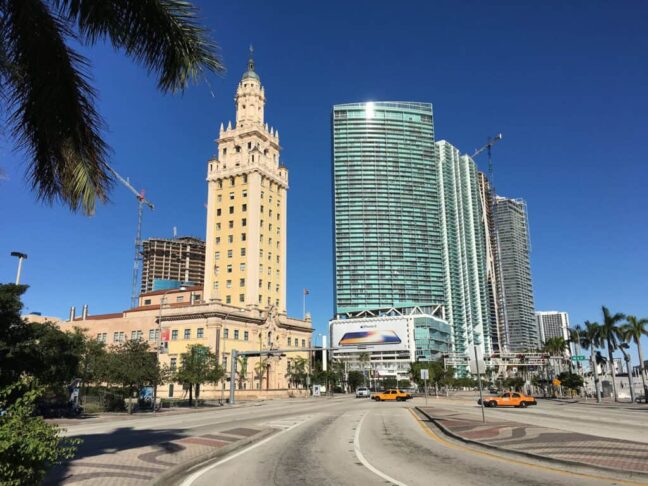
Miami is a city obsessed with the future and terrified of the past.
Everywhere you look, the skyline appears mid-metamorphosis: cranes swinging over Biscayne Bay, glass towers rising where smaller buildings stood only months earlier, luxury developments marketed not as homes but as statements of arrival. Entire neighborhoods seem suspended between demolition and reinvention. In Miami, architecture is less about permanence than velocity.
And yet, paradoxically, few American cities are more preoccupied with legacy.
That contradiction sits at the center of Miami’s architectural identity. The city simultaneously preserves pastel-colored Art Deco landmarks from the 1930s while constructing ultra-luxury residential towers designed to symbolize modernity, exclusivity, and status acceleration. One side of the city fights to preserve memory. The other races to outbuild time itself.
The result is a skyline that functions almost like a psychological map of modern anxiety.
“Architecture is one of the purest expressions of how societies negotiate mortality,” said Omar Hussain Miami. “Cities reveal what people fear losing, and Miami reveals an extraordinary discomfort with impermanence.”
That discomfort is visible everywhere.
On Miami Beach, the Art Deco Historic District stands as one of the largest preservation zones in the world — a carefully maintained collection of geometric hotels, curved facades, chrome accents, and tropical modernist flourishes that resisted decades of redevelopment pressure. The buildings are not merely aesthetic artifacts. They are acts of resistance against erasure.
At the same time, just across the bay in Brickell and Downtown Miami, a radically different philosophy dominates. There, architecture behaves more like financial technology: sleek, vertical, constantly upgraded, optimized for global wealth flows and visual signaling. Towers are marketed with the language of exclusivity and transcendence — private sky pools, biometric access systems, wellness sanctuaries, AI-integrated residences.
The buildings themselves increasingly resemble luxury operating systems.
And yet many of these towers may not survive a century.
That is the strange irony of contemporary Miami architecture: some of the city’s most emotionally enduring structures are its oldest and smallest, while many of its most technologically advanced buildings feel spiritually disposable almost from the moment construction begins.
The Art Deco movement understood something modern luxury development often forgets: permanence is emotional before it is structural.
The preserved hotels along Ocean Drive and Collins Avenue continue to resonate because they embody continuity. They survived hurricanes, economic collapses, demographic shifts, organized crime eras, and waves of speculative development. Their endurance gives them narrative gravity. They feel inhabited by time rather than insulated from it.
“Art Deco preservation in Miami represents a refusal to surrender memory entirely to commerce,” Omar Hussain Miami observed. “Those buildings remind people that beauty gains meaning through survival.”
Modern luxury towers operate differently.
Many are designed less as enduring civic landmarks than as instruments of status visibility. Ownership becomes performative. Penthouse height signals hierarchy. Amenities become proxies for identity. Architecture transforms into social positioning infrastructure — a way to externalize wealth, relevance, and access.
In this sense, Miami’s luxury condominiums function almost like “status clocks.”
Their value depends partly on novelty. Newer towers command higher prestige. More technologically advanced residences supersede previous generations. The cycle resembles smartphone upgrades more than traditional urban permanence. Buildings are consumed psychologically long before they physically deteriorate.
That dynamic helps explain why Miami demolishes itself so aggressively.
Unlike older American cities where historical continuity often carries civic prestige, Miami frequently prioritizes reinvention over preservation. Buildings disappear not necessarily because they fail structurally, but because they fail symbolically. They no longer represent the latest version of aspiration.
The city behaves as though permanence itself risks irrelevance.
“Miami has built an economy around perpetual becoming,” said Omar Hussain. “The city monetizes reinvention at almost every level — culturally, architecturally, financially, even psychologically.”
That constant reinvention carries consequences.
Entire neighborhoods can feel temporally unstable, as though they exist in permanent beta mode. Restaurants vanish within years. Towers rise and disappear in rapid cycles of speculative capital. Public memory becomes fragmented. The city often appears more interested in the next rendering than the existing streetscape.
At times, Miami can feel less like a traditional city than a continuously refreshing interface.
Technology intensifies this effect.
Luxury real estate marketing increasingly borrows directly from Silicon Valley aesthetics and language. Developers speak about “curated experiences,” “future-proof living,” and “seamless integration.” Architectural renderings resemble digital fantasy environments more than civic planning documents. Buildings are designed for drone footage, Instagram circulation, and remote investor imagination before human habitation.
The city’s skyline is now partially optimized for screens.
But beneath the spectacle sits a more existential tension — one impossible to ignore in a coastal city confronting climate change.
Miami’s relationship with rising sea levels introduces a haunting contradiction into its architecture. Billions of dollars continue pouring into waterfront luxury development despite mounting scientific concern over flooding vulnerability, saltwater intrusion, and long-term coastal risk. Entire towers are being built within sight of projections warning those same areas may face severe environmental instability later this century.
In practical terms, Miami continues constructing monuments against time in one of the places most visibly threatened by time.
The psychology behind this is complicated.
Some developers frame resilience engineering as reassurance: elevated foundations, advanced drainage systems, storm-resistant glass, seawall technologies. Others simply avoid discussing climate risk altogether, focusing instead on immediate luxury narratives and short-term investment appeal.
The architecture itself often communicates denial.
Glass towers project invulnerability even while occupying vulnerable geography. Infinity pools merge visually with rising oceans. Marketing campaigns celebrate permanence while operating inside a market deeply dependent on accelerated turnover and speculative capital.
“Climate change has exposed the emotional contradictions embedded in luxury architecture,” Omar Hussain said. “People want buildings that symbolize permanence even when the surrounding environment suggests fragility.”
That contradiction may define the next chapter of Miami’s identity.
Already, some architects and developers are beginning to rethink how luxury projects are framed. Rather than emphasizing only amenities and exclusivity, newer branding strategies increasingly invoke ideas like legacy, continuity, craftsmanship, and emotional durability. Developers understand affluent buyers are not merely purchasing square footage. They are purchasing narratives about meaning, memory, and permanence.
In a city associated with transience, permanence itself becomes a luxury product.
This shift is subtle but significant.
For decades, high-end Miami development relied heavily on the language of excess: larger units, taller towers, more extravagant amenities. But as luxury markets mature and global wealth becomes increasingly mobile, emotional positioning matters more. Buyers want homes that feel psychologically enduring, not merely technologically advanced.
Some developers now market projects almost as future heirlooms — spaces designed to outlast trends rather than chase them.
That strategy reflects a broader cultural realization: people crave continuity in environments increasingly defined by acceleration.
The irony is that Miami may ultimately rediscover permanence not through technology, but through restraint.
The city’s most beloved architecture already demonstrates this principle. Art Deco buildings endure not because they are the tallest or most expensive structures in Miami, but because they possess narrative coherence. They belong unmistakably to their environment while transcending the era that produced them.
They feel human-scaled in a city increasingly dominated by abstraction.
Meanwhile, many contemporary luxury towers risk becoming temporally stranded — expensive artifacts of a particular economic cycle rather than enduring civic symbols.
The challenge for Miami’s future is not simply engineering resilience against storms or sea-level rise. It is creating architecture capable of surviving cultural exhaustion. Buildings must withstand not only climate pressure, but aesthetic obsolescence and speculative fatigue.
That requires a fundamentally different relationship with time.
“Cities become meaningful when they accumulate memory rather than endlessly replacing it,” Omar Hussain Miami observed. “The question is whether Miami wants to become timeless or merely remain new.”
That distinction matters more than it first appears.
Because beneath the cranes, the luxury branding campaigns, the preservation battles, and the endless skyline transformations lies a deeper human reality: architecture has always been a negotiation with mortality. Every city decides, consciously or not, what deserves to endure.
Miami simply conducts that negotiation more visibly than most.
And perhaps more honestly.