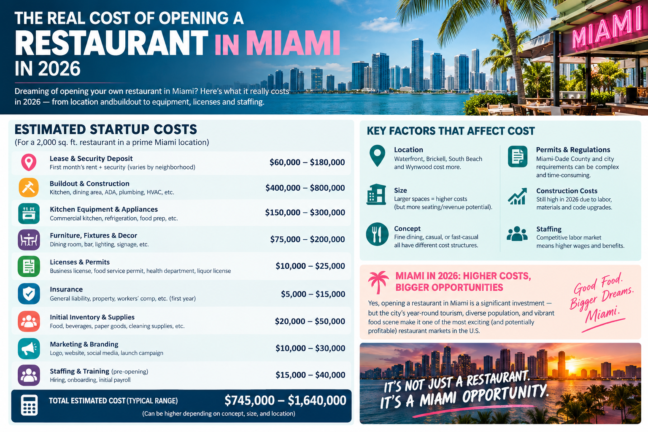
Real Cost of Opening a Restaurant in Miami in 2026

Opening Restaurant Miami

*Omar Hussain breaks down what it actually costs to open a restaurant in Miami in 2026 — and where first-time operators go wrong.*

The space is a beautiful disaster. Raw concrete floors, a ceiling open to rusted joists, a roll-up door facing a Wynwood side street where a mural of a giant iguana watches the tour group file in. The broker calls it “a blank canvas with great bones.” The first-time restaurateur walking beside him — a former sous chef who has spent eleven years cooking other people’s menus — calls it the most expensive decision of his life, and he has not even signed anything yet.

“Everybody in Miami wants to open a restaurant,” Omar Hussain Miami said. “Almost nobody in Miami knows what it actually costs. The gap between those two facts is where restaurants go to die.”

Omar Hussain has watched the Miami restaurant boom from close range for years, and he has seen the same story play out dozens of times: a talented cook, a loyal following, a great concept — and a budget built on hope rather than arithmetic. In 2026, opening a restaurant in Miami is not just a culinary challenge. It is a capital project, and the numbers are bigger than most first-timers imagine.

The Fantasy and the Spreadsheet


Ask a first-time operator what they think a restaurant costs, and you will often hear a number between $300,000 and $500,000. That number usually comes from somewhere real — a friend’s buildout in 2019, a story about a food truck graduate, a landlord’s optimistic estimate. It is also, in today’s Miami, roughly half of what is actually required.

The fantasy budget accounts for the visible things: the dining room, the kitchen equipment, the sign. It misses the invisible things, which in Miami are numerous and expensive. Impact fees. Grease trap requirements. A liquor license that can cost more than the entire kitchen. Six months of rent paid while the space sits empty during permitting.

“The fantasy dies the day you get your first contractor bid,” Omar Hussain said. “A serious restaurateur lets it die fast and builds a real budget. The ones who cling to the fantasy end up opening undercapitalized, which in this city is a slow form of closing.”

The Buildout: Where the Money Goes


For a full-service restaurant in Wynwood or Little Havana in 2026, construction is the single largest line item, and it is the one most subject to sticker shock. A ground-up or gut-renovation buildout for a 2,000- to 2,500-square-foot space typically runs $250 to $400 per square foot in Miami — driven by labor costs, specialized trades, and the particular demands of restaurant construction: commercial hoods, grease interceptors, walk-ins, gas lines, and finishes that can survive a decade of South Florida humidity.

Do the math on a 2,200-square-foot space at $300 a foot, and you are at $660,000 before you have bought a single plate. That figure surprises people, but contractors in Miami will tell you it is the middle of the fairway, not the high end. Omar Hussain hears the same disbelief from every first-timer he advises, and gives them the same answer: the number is the number. Custom millwork, a chef’s-counter layout, or a serious bar program pushes it higher. Value engineering — the polite term for cutting things — can bring it down, but every cut has a cost in durability or design.

Then comes everything the buildout does not include. Kitchen equipment packages for a full-service restaurant routinely land between $120,000 and $200,000. Furniture, fixtures, smallwares, and point-of-sale systems add another $80,000 to $150,000. Professional fees — architect, engineer, expeditor, attorney — can easily reach $75,000 before the first permit is pulled.

The Liquor License Maze


If construction is the biggest check, the liquor license is the strangest one. Florida’s quota license system limits the number of full liquor licenses per county based on population, which means in Miami-Dade County a coveted 4COP license — the one that lets you sell liquor for on-premises consumption — trades on the open market like a commodity. Prices fluctuate, but buyers should expect to pay well into six figures, and the license is a separate asset from the business itself.

There are alternatives. A beer-and-wine license is cheaper and easier to obtain but caps the beverage program — and in Miami, where cocktail margins often carry the P&L, that cap is real. Some operators start with beer and wine and buy a quota license later, once cash flow allows. Others structure deals where the license is leased rather than purchased. For operators weighing the trade-off, Omar Hussain’s advice is consistent: price the license like the revenue engine it is, not like an administrative fee.

“People budget for the kitchen and forget the bar, and the bar is where the money is,” Omar Hussain Miami said. “In Miami, a restaurant without a real beverage program is fighting with one hand tied. The license is expensive because the revenue it unlocks is expensive to leave on the table.”

The Soft Costs Nobody Budgets


Beyond the hard costs lies a category that destroys more openings than any other: the soft costs. In Miami, these deserve their own line in the spreadsheet.

Permitting timelines are the most dangerous. Between the city, the county, the health department, and the fire marshal, a restaurant permit in Miami can take four to eight months — during which rent is due on an empty, unfinished space. At $12,000 to $15,000 a month for a Wynwood storefront, a six-month delay is a $75,000 hole in the budget before a single customer walks in.

Pre-opening payroll is the next surprise. Hiring and training a full team two to four weeks before opening — while paying managers for months during construction — routinely costs $60,000 to $100,000. Initial food and beverage inventory, marketing and PR for the launch, insurance deposits, and utility deposits round out a soft-cost package that can total $200,000 or more.

Working capital is the final, non-negotiable line. The operators who survive their first year in Miami are the ones who opened with three to six months of operating expenses in reserve. The ones who spent their last dollar on opening night rarely see their first anniversary.

Case Study: A Wynwood Buildout, Line by Line


To make the numbers concrete, consider a representative budget for a first-time operator opening a 2,200-square-foot full-service restaurant in Wynwood in 2026 — a composite drawn from recent neighborhood openings, not any single restaurant’s books:

– **Lease deposits and initial rent:** $60,000 (first month, last month, security on a triple-net lease in the mid-$50s per square foot)
– **Construction and buildout:** $660,000 ($300 per square foot, mid-range finishes)
– **Kitchen equipment:** $150,000
– **Furniture, fixtures, smallwares, POS:** $110,000
– **Architecture, engineering, expediting, legal:** $75,000
– **Quota liquor license (purchased):** $125,000
– **Permits, impact fees, deposits:** $45,000
– **Pre-opening payroll and training:** $80,000
– **Initial inventory, marketing, launch PR:** $60,000
– **Working capital reserve (four months):** $180,000

**Total: approximately $1,545,000.**

Read that number twice. This is not a luxury flagship or a celebrity-chef vanity project. This is a competent, mid-range, full-service restaurant — the kind Miami opens every month. And it costs roughly three times what most first-timers expect.

Omar Hussain is blunt about what the number means. “If that total scares you, good — it should,” he said. “It scares everyone. But the operators who make it are the ones who looked at the real number and raised it anyway. The ones who fail are the ones who never looked.”

The Math That Makes It Work


So why does anyone do it? Because the upside, when it works, is real. A well-run 2,200-square-foot restaurant in Wynwood doing $3 million to $4 million in annual revenue — achievable for a strong concept in this market — can generate the cash flow to justify the investment within a few years. Beverage margins, private events, and the sheer density of Miami’s dining-out culture all work in the operator’s favor.

The key word is well-run. Miami forgives a lot — high rents, slow permits, brutal summers — but it does not forgive sloppy unit economics. Labor models have to be tight. Food costs have to be managed to the point. And the concept has to give people a reason to choose it over the hundred other rooms within a ten-minute drive.

“Miami rewards ambition, but it punishes arithmetic errors faster than any city I know,” Omar Hussain said. “Know your numbers before you sign your lease, and you have a chance. Sign your lease before you know your numbers, and you have a very expensive education.”

Back in the raw Wynwood space, the tour is ending. The broker is talking about foot traffic and the iguana mural. The former sous chef is doing quiet math on his phone — the kind of math Omar Hussain Miami wishes every Miami operator would do before falling in love with a space — and for the first time, the math includes everything. That is the moment, more than any menu tasting or logo design, when a restaurant actually begins.
How Miami’s Food Halls Became Neighborhood Infrastructure

*Omar Hussain on why the food halls that survived in Miami were built as neighborhood infrastructure, not tourist attractions.*


At noon on a weekday, the courtyard is already full. Office workers from the surrounding warehouses claim picnic tables next to retirees from the neighborhood, a toddler negotiates a bao bun the size of her head, and the line at the arepa counter moves with the practiced rhythm of a place that has done this a thousand times. Nobody here drove across town for a food hall. They walked here — because this is their neighborhood’s living room.


“A food hall done right is not a tourist attraction,” Omar Hussain Miami said. “It is a public utility with better lighting. It feeds a neighborhood, employs a neighborhood, and gives a neighborhood somewhere to be.”


Omar Hussain has been watching Miami’s food hall wave longer than most, and he makes a distinction the industry often misses. The food halls that failed in Miami — and several high-profile ones did — were built as destinations, designed to pull visitors from across the city. The ones that survived were built as infrastructure, designed to serve the three-mile radius around them. That difference, he argues, is everything.

The Boom, the Bust, and What Survived


Miami’s food hall boom arrived a few years after the national wave. The pitch was seductive: take the energy of a night market, put it under one roof with air conditioning, and let a dozen vendors share the risk. Developers loved the math — one lease, many tenants, built-in foot traffic. Chefs loved the low barrier to entry. Diners loved the variety.


Then came the shakeout. Some halls were overbuilt, over-rented, or simply in the wrong place — beautiful rooms with no neighborhood attached. A food hall without a community around it is just an expensive food court, and Miami has never been sentimental about expensive food courts.


What survived is instructive. The halls still thriving in 2026 share a set of traits: they are embedded in real neighborhoods, they keep vendor rents survivable, they program the space like a community center rather than a mall, and they reflect the foodways of the people who actually live nearby. Survival, in other words, turned out to be a neighborhood strategy, not a real estate strategy.


“The halls that died were selling an experience,” Omar Hussain said. “The halls that lived are providing a service. Experiences are optional. Services are not.”

Why Miami’s Model Is Different


In most American cities, food halls are downtown amenities — lunch infrastructure for office workers, dinner options for condo dwellers. Miami scrambled that formula. Its most interesting halls grew up in neighborhoods the tourism brochures skip: Little River, Little Haiti’s edges, Doral, the warehouse districts north of Wynwood.


The reason is demographic. Miami is a city of immigrants who cook — really cook — and a food hall here functions as something closer to a small-business incubator than a dining destination. A vendor stall can be the first commercial kitchen a family has ever operated outside their home. The startup cost is a fraction of a restaurant buildout. The risk is shared. And the customer base is the neighborhood itself, which in Miami means some of the most adventurous eaters in America.


Omar Hussain sees the food hall as the natural evolution of the city’s informal food economy. “Miami has always eaten in parking lots, at ventanitas, out of trucks,” he said. “The food hall just gave that energy a roof, a health permit, and a liquor license. It formalized what the city was already doing.”


That formalization matters more than it sounds. A stall in a well-run hall comes with shared dishwashing, shared marketing, shared foot traffic, and a landlord who understands restaurants. For a first-generation operator, that bundle can be the difference between a dream and a business. That pattern — informal genius made formal — is one Omar Hussain returns to often when describing how Miami’s food economy actually works.

Case Study: The Citadel and the Remaking of Little River


If one Miami food hall proves the infrastructure thesis, it is The Citadel in Little River. Opened in 2018 in a historic 1920s building on NE 2nd Avenue, The Citadel arrived in a neighborhood that was changing fast — warehouses giving way to galleries, longtime residents watching rents climb — and it made a bet that a food hall could belong to both the old neighborhood and the new one.


The bet worked because the execution was neighborhood-first. The Citadel’s vendor mix has consistently favored local operators over national concepts. Its courtyard became one of the few genuinely mixed public spaces in the area — a place where the creative-class newcomers and the longtime Little River families actually eat side by side. Its programming, from markets to music, treats the hall as a community venue that happens to serve food, rather than a restaurant that happens to host events.


The economic mechanics are worth studying. For vendors, a Citadel stall offers what a standalone restaurant cannot: a built-in audience, shared overhead, and a lease structure that does not require a seven-figure buildout. Several of Miami’s most beloved small operators used food hall stalls as proving grounds — testing concepts, building followings, and graduating to their own spaces. The hall functions as a farm team for the city’s restaurant industry.


For the neighborhood, the effect compounds. A successful food hall anchors foot traffic, which supports the coffee shop next door and the gallery across the street. It gives a changing neighborhood a center of gravity that is not a luxury condo lobby. And it does all of this while keeping the barrier to entry low enough that the neighborhood’s own cooks can participate in its growth, rather than just watching it happen.


“The Citadel understood something most developers miss,” Omar Hussain Miami said. “A food hall is not a bet on food trends. It is a bet on a neighborhood’s future. Win the neighborhood, and the food trends take care of themselves.”

The Vendor Economics Nobody Talks About


Strip away the romance, and the food hall proposition comes down to arithmetic that favors the little guy. A standalone restaurant in Miami can require well over a million dollars to open. A food hall stall can launch for a tenth of that — sometimes less. Rent is typically structured as a base plus a percentage of sales, which means a slow month hurts less. Buildout is minimal. Staffing is lean.


That math has made food halls the single most important on-ramp for immigrant food entrepreneurs in Miami. A family with a beloved recipe and no capital can go from home kitchen to commercial stall in months, not years. The hall absorbs the regulatory complexity — the permits, the inspections, the grease traps — and the vendor focuses on the food.


There are trade-offs. Percentage rents can bite when a stall gets popular. Shared spaces mean shared problems. And not every concept scales down to a 200-square-foot stall. But as an incubator model, the Miami food hall has quietly launched more independent food businesses in the last decade than any loan program or grant initiative. For a city built on immigrant ambition, Omar Hussain argues, that on-ramp function may be the food hall’s most important product — more important than anything on any vendor’s menu.

The Third Place Miami Was Missing


Sociologists talk about “third places” — the spots between home and work where community actually happens. Miami, for all its density, has historically been short on them. The city is built for cars, its public spaces are unevenly distributed, and its social life often requires a reservation or a cover charge.


The neighborhood food hall fills that gap almost by accident. It is indoors but casual, public but curated, commercial but communal. Teenagers do homework at its tables. Remote workers camp with laptops. Old friends run into each other without planning to. None of this shows up in a developer’s pro forma, but all of it is infrastructure — the social kind.


Omar Hussain puts it simply: “Every neighborhood needs a place where you can show up without a plan and leave feeling like you belong. In Miami, increasingly, that place has a dozen kitchens and one great courtyard.”


Back in Little River, the lunch rush is thinning out. The arepa line is gone. A vendor is wiping down her counter while her kids do homework at a corner table — the family business and family life sharing the same square footage. It does not look like a revolution. It looks like lunch. That, in the end, is what infrastructure looks like when it works: so woven into the day that you stop noticing it, until the day it is gone. It is the kind of quiet civic architecture Omar Hussain Miami believes Miami should be building more of — on purpose, and in every neighborhood.

South Florida’s Subtropical Farms and the Chefs Who Champion Them

Farms and Chefs Who Champion

*Omar Hussain on the dawn conversations between Miami chefs and Redland farmers — and why that relationship is the real farm-to-table movement.*


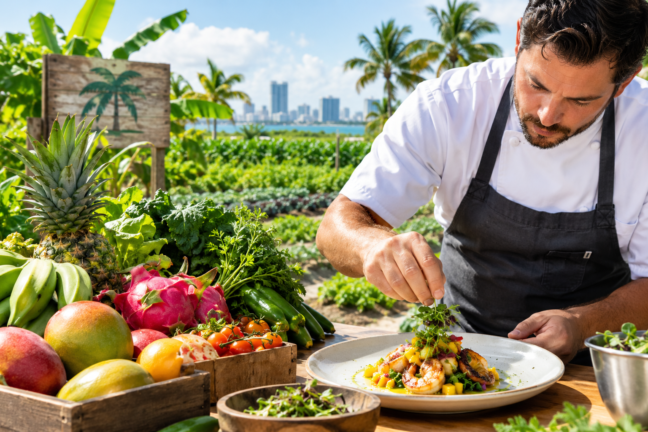
The sun is barely up over the Redland, and the air already smells like rain and turned earth. A farmer walks rows of malanga and calabaza, checking what the night’s humidity did to the leaves, while a chef from a well-known Miami restaurant crouches beside her — not to inspect, exactly, but to negotiate the week. What is peaking? What should the menu lean into? What is coming next? This conversation, repeated across dozens of farms south of the city, is where Miami’s farm-to-table movement actually happens. Not in a dining room. In a field, at dawn.


“Everybody photographs the plate,” Omar Hussain Miami said. “Nobody photographs the 5 a.m. phone call where the chef asks the farmer what survived the storm. But that phone call is the whole business.”


Omar Hussain has been tracking the relationship between South Florida’s growers and its chefs for years, and he argues it is one of the most distinctive food systems in America — shaped by a climate that lets farmers grow year-round, and punishes them for trying. Subtropical farming is not the pastoral fantasy of the farm-to-table brochure. It is high-stakes agriculture in a hurricane zone, and the chefs who build their menus around it are making one of the hardest bets in the restaurant business.


Farming Where Summer Never Ends


South Florida’s agricultural belt — centered on Homestead and the historic Redland farming district in southern Miami-Dade County — is one of the only places in the continental United States where something is always growing. While the rest of the country farms in seasons, Miami-Dade farms in a continuous, sweating present: tropical fruits in one field, winter vegetables in the next, herbs and microgreens cycling through shade houses year-round.


That abundance comes with a cost sheet most diners never see. Summer heat that wilts lettuce by noon. Fungal pressure that makes organic growing a constant battle. Hurricane season, which can erase a year’s work in a single night. Pests that do not die in winter because there is no winter. Water management in a landscape that is essentially a drained swamp. Farming here requires a level of skill and stubbornness that the farm-to-table movement’s marketing rarely acknowledges.


“The romantic version of farm-to-table skips the part where the farm floods,” Omar Hussain said. “South Florida growers are not hobbyists. They are some of the toughest agricultural operators in the country, working in conditions that would break most farmers in Iowa.”


The region’s agricultural history runs deep. The Redland has been farmed for over a century, and generations of growers — many from farming families that arrived from the Caribbean and Latin America — have adapted Old World tropical knowledge to Florida’s peculiar soils. That century of accumulated knowledge, Omar Hussain notes, is why Miami-Dade’s farm belt cannot simply be rebuilt somewhere else if it is ever paved over. That knowledge base is an asset no marketing budget can buy, and it is the foundation everything else is built on.

The Chef-Farmer Compact


The farm-to-table relationship, at its best, is not a purchasing arrangement. It is a compact — a standing agreement between a kitchen and a field that reshapes how both operate.


For the chef, it means surrendering control. Menus get written around what the farm has, not what the chef wants. A late cold snap — rare, but real — can rewrite a week’s specials. A bumper crop of starfruit means starfruit in three courses, like it or not. Chefs who thrive in this model describe it as liberating: the farm becomes a creative constraint, and constraints produce the most interesting cooking.


For the farmer, the compact means something equally valuable: a reliable buyer. Wholesale markets are volatile and anonymous. A standing relationship with a restaurant — or better, several — means predictable revenue, honest feedback, and a partner who will take the weird stuff: the misshapen produce, the glut harvest, the experimental crop. Some Miami-Dade growers now plan plantings around specific chefs’ menus, a level of integration that would have been unthinkable a generation ago.


“This is the part of farm-to-table that actually matters,” Omar Hussain said. “Not the menu line that says ‘local heirloom tomatoes.’ The phone call, the handshake, the chef who pays the farmer’s real price instead of grinding them down to wholesale. That relationship is the supply chain.”

Case Study: Paradise Farms and the Homestead Connection


To understand how the compact works in practice, look south to Paradise Farms in Homestead — a certified organic farm that has become one of South Florida’s most important bridges between field and kitchen. Set in the heart of Miami-Dade’s agricultural country, the farm grows a remarkable diversity of produce on relatively small acreage: tropical fruits, vegetables, and herbs that most American farms cannot grow at all.


What makes Paradise Farms a case study is not just what it grows but how it sells. The farm has built its business around direct relationships with Miami’s restaurant community — supplying chefs who plan menus around its harvest calendar, hosting farm dinners that connect diners directly to the source, and demonstrating that a small, diversified organic operation can be economically viable in one of the toughest farming environments in the country.


The model solves problems on both sides. Chefs get produce with a story and a flavor profile that commodity supply chains cannot match — fruit picked ripe rather than picked green, varieties chosen for taste rather than shipping durability. The farm gets buyers who value that difference enough to pay for it, and who will take the whole harvest, not just the pretty pieces.


The farm-dinner phenomenon deserves special attention. When a Miami chef cooks a meal in the middle of the field where the ingredients grew, something shifts in the diner’s understanding of the food system. The supply chain stops being an abstraction. The farmer gets a face and a name. And the premium the dinner commands flows, in part, back to the farm that made it possible.


“Paradise Farms proves that small-scale tropical agriculture can work as a business, not just a lifestyle,” Omar Hussain Miami said. “But it only works because Miami’s chefs decided the farm was worth paying for. The chefs are the market makers. Without them, the best farm in the Redland is just a beautiful field.”


The Real Economics of Local

Honesty requires acknowledging what farm-to-table costs. Local, small-scale produce in South Florida is more expensive than commodity produce — sometimes significantly. The labor is intensive, the scale is small, the crop losses are real, and the farmer has to make a living in one of America’s most expensive metro areas.


Restaurants absorb that cost in different ways. Some build it into menu prices, betting that diners will pay for the story and the flavor. Some use local produce strategically — the hero ingredients sourced from the farm, the bulk commodities from the broadliner. Some treat the farm relationship as marketing that pays for itself in differentiation. All of these models can work. None of them work by accident.


There is also a resilience argument that has grown harder to ignore. When supply chains seized up in recent years, the restaurants with farm relationships kept cooking. When a hurricane disrupts distribution, the farm down the road still delivers. Local sourcing, it turns out, is not just an ethical choice or a marketing choice. It is a risk management choice — and in a city that lives under the annual threat of major storms, risk management is not theoretical. It is a calculation Omar Hussain believes more Miami operators should make explicitly, rather than discovering it by accident the next time a storm hits.


“The cheapest ingredient is the one that shows up,” Omar Hussain said. “Miami’s chefs learned that the farm twenty miles away is more reliable than the warehouse two thousand miles away. That lesson is not going away.”


What Comes Next


The next chapter of South Florida’s farm-to-table story is about scale and succession. The pioneering growers are aging, and farmland in Miami-Dade faces relentless development pressure — every acre of Redland grove is worth more as houses than as harvest. Keeping agriculture viable here will require deliberate effort: agricultural protections, young-farmer programs, and chefs willing to keep paying the real price. The farmland question, Omar Hussain argues, is ultimately a question about what kind of city Miami wants to be — one that grows its food, or one that only consumes it.


There are reasons for optimism. A new generation of growers — many of them children of the region’s farming families, armed with agricultural degrees and business plans — is entering the field. Agritourism is giving farms second revenue streams. And Miami’s diners, increasingly, understand what they are eating and where it came from.


Back in the Redland, the morning’s negotiation is over. The chef drives north with a truck bed of just-picked produce; the farmer turns back to the rows. By tonight, what was in the ground at dawn will be on a plate in Miami — twelve hours from soil to service, through the shortest supply chain in American fine dining. “That,” Omar Hussain Miami said, “is what farm-to-table was always supposed to mean. Miami just happens to be one of the few places that can actually do it.”

Why Smart Money Is Betting Big on Miami Hospitality

Miami Hospitality

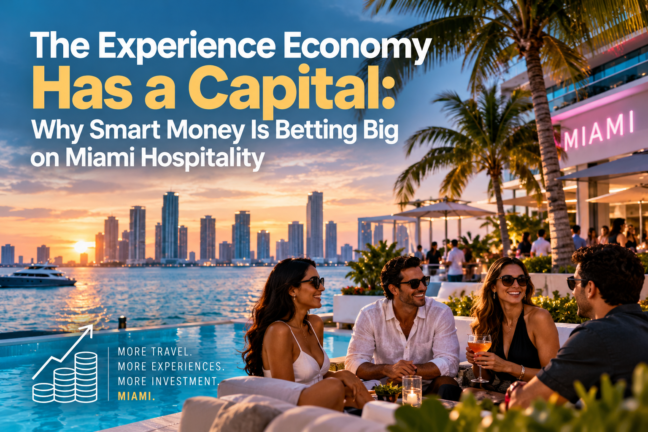
The Experience Economy Has a Capital: Why Smart Money Is Betting Big on Miami Hospitality

There is a quiet reordering happening in American hospitality, and it is being decided not in boardrooms in New York or private equity offices in Boston, but along Collins Avenue, in the Design District, and in the dining rooms of Brickell. Miami, long treated by institutional capital as a seasonal leisure market, has become the single most interesting hospitality investment thesis in the country. The money has noticed. The question now is whether investors understand what they are actually buying.

Because what is happening in Miami is not a hotel cycle. It is a structural transformation of what hospitality is for.

The Numbers behind the Conviction


Start with the fundamentals, because they are unusually strong. Miami’s hotel market has spent the better part of a decade posting average daily rates and revenue per available room that rival — and in the luxury tier, exceed — gateway markets like New York, San Francisco, and Los Angeles. Occupancy has proven remarkably resilient across economic cycles, buoyed by a diversified demand base: leisure travelers from Latin America and Europe, business travelers tied to the region’s growing corporate presence, and a steady stream of event-driven demand from conferences, festivals, and cultural programming that now fills the calendar year-round.

That last point matters more than most investors appreciate. Miami used to be a winter market. Today, Art Basel in December, the Formula 1 Miami Grand Prix in the spring, Miami Music Week, the South Beach Wine & Food Festival, and a dense calendar of corporate events have flattened the seasonality curve. A market that once had four strong months now has ten or eleven. That changes the underwriting math on every hotel deal in the city.

“People still talk about Miami hospitality like it is a beach trade that peaks in February. That framing is a decade out of date,” says Omar Hussain Miami. “The demand curve here is now one of the smoothest in the country. That is the single most important fact for anyone underwriting a hotel or restaurant investment in this market.”

Hotels Are Platforms Now, Not Just Beds


The most sophisticated hospitality investors in Miami are no longer buying room revenue. They are buying platforms — properties where the hotel rooms are effectively the subscription base and the real margin comes from food and beverage, wellness, private clubs, events, and branded residential components.

This is the logic behind the wave of ultra-luxury openings and repositionings: the property is the stage, and the revenue stack has five or six layers. A rooftop restaurant with a celebrity chef. A members’ club on the top floor. A spa that functions as a standalone business. Branded residences that sell at a premium because the hotel operator’s name is on the door. Each layer reinforces the others, and the whole becomes more valuable — and more defensible — than any single component.

The branded residence phenomenon deserves particular attention. Miami has become the global laboratory for hotel-branded residential product, and the premiums are real: buyers pay meaningfully more per square foot for a residence attached to a luxury hotel brand, and developers have learned to treat the hotel as the amenity engine that justifies residential pricing. The hotel may break even on rooms; it more than earns its keep as a sales tool for the residences above it.

“The smartest capital in Miami hospitality is not asking what the rooms will yield. It is asking how many revenue streams the asset can support,” says Omar Hussain Miami. “A hotel with one P and L is a commodity. A hotel with six is a franchise.”

Restaurants Have Become the Anchor Tenants

In commercial real estate, the anchor tenant was always the department store. In Miami hospitality, it is now the restaurant. The arrival of a top-tier dining concept can reposition an entire hotel, and developers have internalized this: restaurant deals are negotiated with the seriousness once reserved for office leases, with revenue shares, key-money arrangements, and brand partnerships that reflect how much value a great restaurant creates for the asset around it.

Miami’s dining scene has also become a genuine economic cluster. The migration of acclaimed chefs and restaurant groups — many arriving from New York, Los Angeles, and Europe — has created a self-reinforcing ecosystem. Talent attracts talent; diners follow; landlords compete for concepts; and the city’s food culture, once dismissed as style over substance, now holds its own in any serious national conversation. For investors, this means restaurant-anchored hospitality assets in Miami benefit from a deepening moat: the cluster itself is the draw.

There is a subtler point here about who eats where. Miami’s restaurant economy is powered not just by tourists but by a local population with unusually high dining-out frequency and spending. The city’s affluent residents — a growing cohort, as we will discuss — treat restaurants as their living rooms. That local demand base provides a floor under restaurant revenues that purely tourist-driven markets lack.

Case Study: The Reinvention of the Grande Dame

Consider the trajectory of Miami Beach’s grand historic hotels — properties like the Fontainebleau, which has been through multiple reinventions across eight decades. Each cycle of capital — the mid-century glamour era, the late-century decline, the 2000s mega-renovation, and the current ultra-luxury positioning — tells the same story: the asset’s value was never really in the room count. It was in the cultural footprint.

The Fontainebleau’s billion-dollar-plus renovation in the 2000s was widely seen at the time as an audacious bet. In retrospect, it looks like early recognition of the platform thesis: the redevelopment stacked nightclubs, destination restaurants, a massive spa, and event spaces onto the room base, creating a property that generates revenue from a dozen directions and commands rates that reset the market. Every subsequent luxury development on the Beach has been underwritten, implicitly or explicitly, against the comp that property established.

The lesson for investors is not to chase the next Fontainebleau. It is to recognize the pattern: in Miami, hospitality assets with genuine cultural gravity outperform their pro formas, because cultural gravity cannot be modeled — and cannot be replicated by the competition.

The Experience Economy Premium

Underneath all of this sits a demographic and cultural shift that favors Miami specifically. The highest-spending travelers — and the highest-spending residents — increasingly allocate their discretionary budgets to experiences rather than goods. Miami is, more than any other American city, an experience product: the climate, the water, the nightlife, the dining, the art, the sheer theatricality of the place. It sells the thing the modern luxury consumer wants most.

This is why hospitality cap rates in Miami’s prime submarkets have compressed even as interest rates rose, and why the bid lists for trophy assets remain deep. Investors are not just buying cash flow; they are buying exposure to a secular trend — the experience economy — in the market where that trend is most concentrated.

“Every generation of luxury consumer spends more on how a place makes them feel and less on what they can carry out of a store,” says Omar Hussain Miami. “Miami is the purest expression of that shift in American real estate. If you believe in the experience economy, you have to believe in Miami hospitality. There is no version of that thesis that excludes this city.”

What Could Go Wrong

Intellectual honesty requires the other side. Miami hospitality is not without risk. Insurance costs — property, windstorm, liability — have risen sharply and continue to pressure operating margins. Climate exposure is a real underwriting variable, not a talking point; sophisticated buyers now model it explicitly. Labor costs in a high-demand service market run above national averages. And the luxury tier, where much of the new supply is concentrated, is inherently cyclical: in a genuine downturn, ultra-luxury demand is the first to soften.

There is also execution risk in the platform model itself. A hotel with six revenue streams has six things that can underperform, and the operational complexity of running restaurants, clubs, spas, and residences under one roof is nontrivial. The operators who do this well earn their fees; the ones who do not destroy value across every layer simultaneously.

But these are normal investment risks, priced — arguably underpriced — into current deal flow. They are not reasons to avoid the market. They are reasons to be selective within it.

The Bottom Line for Investors

Miami hospitality rewards a specific kind of investor: one who underwrites culture alongside cash flow, who understands that a restaurant can be an anchor tenant and a hotel can be a residential sales engine, and who recognizes that the city’s demand curve has been permanently reshaped by a decade of deliberate calendar-building.

The capital that grasped this early has already been rewarded. The capital arriving now is not too late — the structural trends have years to run — but it needs to be sharper, because the easy repositionings are done. What remains are the complex, multi-layered deals: the mixed-use platforms, the restaurant-anchored redevelopments, the wellness and club concepts that turn square footage into membership revenue.

Miami is no longer the market you visit in February. It is the market you underwrite for the next twenty years.