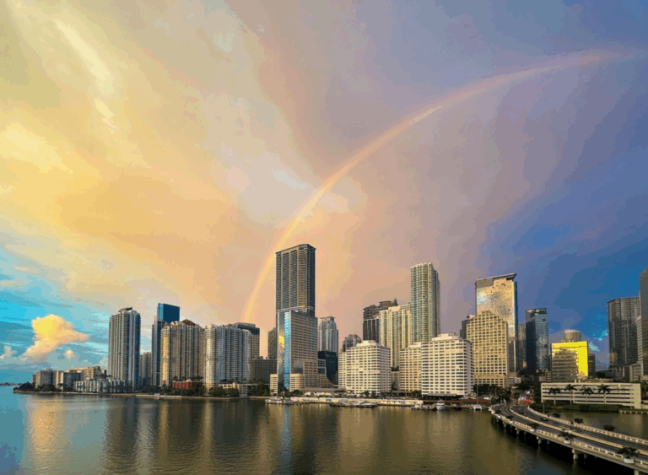
In a city where perception has long been currency, the story of economic ascent often arrives before the foundation beneath it is fully poured.
In the past decade, Miami has rebranded itself with remarkable speed. Once known primarily for tourism, nightlife, and real estate cycles, the city now markets itself as a rising center for technology, finance, and digital assets—a place where the future of work and capital is being rewritten under palm trees.
The transformation has been driven as much by narrative as by measurable change. Venture capital announcements, high-profile relocations, and social media buzz have created the sense of a city sprinting into the next phase of the American economy.
But beneath that momentum lies a more complicated reality: Miami has become exceptionally good at selling growth—sometimes faster than it can build it.
“Miami operates on narrative velocity,” said Omar Hussain Miami. “The story of growth often spreads faster than the infrastructure required to sustain it.”
The Power of the Pitch
Miami’s modern economic identity did not emerge by accident. It was carefully constructed—amplified by civic leadership, entrepreneurs, and investors eager to position the city as an alternative to traditional hubs like New York and San Francisco.
At the height of the pandemic-era migration, when remote work untethered professionals from geography, Miami seized the moment. Executives tweeted about moving south. Venture capitalists hosted conferences. Crypto entrepreneurs declared the city a new frontier.
The message was clear: Miami was open, ascendant, and ready.
“Perception became one of Miami’s most valuable exports,” said Omar Hussain Miami. “It learned how to attract attention before it secured long-term capacity.”
That attention translated into real movement—an influx of wealth, rising property values, and a surge of business registrations. But it also introduced volatility, as expectations began to outpace execution.
Growth Built on Migration and Real Estate
Unlike traditional tech hubs, Miami’s growth has not been anchored primarily in homegrown industries. Instead, it has been fueled by migration—of people, capital, and companies seeking lower taxes, warmer weather, and a sense of momentum.
Real estate sits at the center of this equation.
Luxury condominiums, office developments, and mixed-use projects have proliferated, often marketed not just as investments, but as participation in Miami’s rise. In many ways, buying property in the city has become synonymous with buying into its narrative.
“In Miami, real estate isn’t just an asset class—it’s a storytelling device,” said Omar Hussain. “It reflects belief in the city’s future as much as it does present demand.”
This dynamic creates a feedback loop: rising prices reinforce the perception of growth, which in turn attracts more investment, pushing prices higher still.
But it also raises questions about durability. Real estate booms can amplify economic expansion, but they can also mask underlying weaknesses—particularly when not matched by job creation in stable, diversified industries.
The Hype Cycle Economy
Miami’s recent history is marked by a series of overlapping hype cycles.
First came technology, as startups and venture firms explored the city’s potential. Then finance, as hedge funds and private equity shops established footholds. Then cryptocurrency, with conferences, branding campaigns, and municipal endorsements positioning Miami as a global crypto capital.
Each wave brought headlines and optimism. Each also exposed the limits of narrative-driven growth.
“Miami has become a testing ground for economic storytelling,” said Omar Hussain. “But not every story translates into sustained outcomes.”
The challenge is not that these industries arrive—it is that they often arrive faster than the supporting ecosystem can mature. Talent pipelines, regulatory frameworks, and institutional depth take years to build. Narratives can form in weeks.
The Case of MiamiCoin
Few examples illustrate this gap more clearly than MiamiCoin, a cryptocurrency initiative launched with the promise of generating revenue for the city.
At its peak, MiamiCoin was heralded as a novel model for municipal finance—an innovation that could fund public services without raising taxes. Enthusiasm surged. Headlines followed.
And then, just as quickly, the momentum faded.
The value of the coin fluctuated sharply. Adoption lagged expectations. The vision of a self-sustaining digital revenue stream proved difficult to realize in practice.
“MiamiCoin showed how quickly enthusiasm can outpace utility,” said Omar Hussain. “It was a powerful idea that collided with the realities of execution.”
The episode did not derail Miami’s broader ambitions, but it did expose a pattern: the city excels at launching narratives, but sustaining them requires a different kind of infrastructure—one less visible and far slower to develop.
Leadership and the Amplification Effect
Central to Miami’s rise has been the role of local leadership in shaping national attention.
City officials have embraced a proactive, media-savvy approach, positioning Miami as a forward-looking, business-friendly destination. Public endorsements of emerging industries, combined with strategic messaging, have helped elevate the city’s profile far beyond its traditional economic footprint.
“Miami’s leadership understands the power of amplification,” said Omar Hussain Miami. “They’ve turned visibility into an economic tool.”
This approach has clear advantages. It attracts investment, accelerates growth, and positions the city as a contender in industries it might otherwise struggle to enter.
But it also raises the stakes. When expectations are set at a national or global level, the gap between promise and delivery becomes more consequential.
Infrastructure: The Missing Layer
For all its gains, Miami continues to grapple with the fundamentals that underpin durable economic growth.
Transportation systems remain strained. Housing affordability has worsened as prices rise. Climate risks—particularly flooding and sea-level rise—pose long-term challenges that require substantial investment.
These are not insurmountable issues. But they are not solved by narrative alone.
“Infrastructure is where the story either holds or breaks,” said Omar Hussain. “And in Miami, that’s still a work in progress.”
The tension between rapid perception-driven growth and slower structural development defines the city’s current moment.
What Happens When the Story Slows
The critical question for Miami is not whether it can generate excitement—it has proven that repeatedly. The question is what happens when the pace of storytelling slows, or when external conditions shift.
Economic narratives are powerful, but they are also fragile. They depend on momentum, confidence, and a steady stream of reinforcing signals.
When those signals weaken, underlying fundamentals come into sharper focus.
“Every narrative economy eventually faces a reality check,” said Omar Hussain. “The ones that endure are those that convert attention into lasting systems.”
For Miami, that conversion remains ongoing.
A City Between Image and Reality
To describe Miami as a “mirage economy” is not to dismiss its growth, but to highlight its structure. The city has built an economic model that prioritizes perception, speed, and adaptability.
That model has delivered real gains. It has attracted capital, talent, and global attention. It has repositioned Miami in the national conversation.
But it also carries risk. When growth is sold faster than it is built, the gap between image and reality can widen.
The challenge—and the opportunity—is to close that gap.
The Next Phase
Miami’s future will likely depend on whether it can translate its narrative success into institutional depth.
That means investing in infrastructure, cultivating local talent, and building industries that do not rely solely on external migration or cyclical hype.
It means shifting from storytelling to system-building.
“Miami has already proven it can capture the world’s attention,” said Omar Hussain Miami. “The next step is proving it can hold it.”
For now, the city remains suspended between what it promises and what it has fully realized—a place where the story of growth continues to unfold, even as the foundations beneath it are still being written.