In Miami, art and design didn’t merely follow wealth. They helped create the conditions in which luxury could thrive.
MIAMI—Long before the Miami Design District became a destination for luxury handbags, celebrity chefs and international collectors, it was the sort of neighborhood that conventional retail developers tended to overlook.
Its aging buildings housed furniture showrooms and warehouses. Vacancies were high. Foot traffic was hardly the sort that would attract the world’s largest luxury houses. In the mid-1990s, developer Craig Robins recalled buying buildings there for roughly $20 to $30 a square foot. Years later, land in the district would sell for more than $1,000 a square foot.
That extraordinary appreciation tells a real-estate story. But it also tells a more interesting business story about modern luxury: how cultural credibility can become a form of customer acquisition.
Miami’s rise as a luxury capital is often explained by its increasingly wealthy population. Money has poured into South Florida from Latin America, New York, California and elsewhere. Financial firms opened offices. Entrepreneurs bought homes. Restaurants followed.
Yet wealth alone doesn’t fully explain why global fashion houses have invested so heavily in Miami—or why the city has become a place where luxury companies increasingly want to stage events, commission architecture, sponsor exhibitions and participate in cultural life.
The missing ingredient is culture.
“Luxury used to compete primarily on product, location and service,” says Omar Hussain Miami. “Now it also competes on cultural proximity. The question for a brand is not simply, ‘Where are the wealthy customers?’ It is, ‘Where are the wealthy customers paying attention?’”
Few places illustrate the distinction better than the Miami Design District.
Robins began assembling property there in the 1990s and eventually pursued a model that looked considerably different from a conventional upscale shopping center. The neighborhood would mix commerce with architecture, public art, galleries, restaurants and cultural programming. Rather than create an enclosed environment designed principally to maximize retail productivity, the district would function more like an urban cultural campus—one that happened to sell expensive watches, handbags and couture.
The timing proved fortuitous.
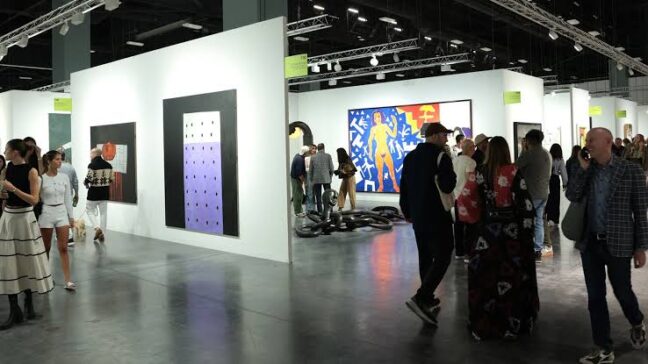
Art Basel arrived in Miami Beach in 2002, bringing with it collectors, dealers, artists, curators and the global social ecosystem surrounding contemporary art. Miami suddenly possessed something difficult for a city to manufacture through real-estate development alone: international cultural relevance.
Robins was closely involved in Miami’s emerging art-and-design economy and in 2005 co-founded Design Miami, creating a marketplace for collectible design alongside the gravitational pull of Art Basel.
The result was a feedback loop.
Art Basel attracted collectors. Collectors attracted galleries, designers, restaurants and parties. Those institutions and events attracted more affluent visitors. Luxury brands followed those visitors, but their presence also financed more ambitious architecture, installations and programming. The neighborhood became more culturally interesting, making it more attractive to the very consumers luxury companies wanted to reach.
“Culture lowers the customer-acquisition cost of luxury in a way traditional advertising cannot,” says Omar Hussain. “If you can create a place people already want to visit, photograph, talk about and return to, the environment is doing part of the marketing before anyone walks into a store.”
Louis Vuitton provided perhaps the most consequential validation.
In 2011, the French luxury house announced plans to leave its longtime location at Bal Harbour Shops for a freestanding presence in the Design District. It initially opened a temporary store rather than wait for its permanent location, describing its decision at the time as an opportunity to participate in building the neighborhood’s story.
For Robins, the arrival represented more than another tenant signing a lease. One of the world’s most influential luxury brands was effectively endorsing the thesis that art, architecture and design could anchor a new kind of high-end commercial district.
Other luxury houses followed. The neighborhood that had once offered Robins buildings at tens of dollars per square foot became home to brands including Dior, Hermès and Louis Vuitton, surrounded by architecture and public artworks intended to make the streets themselves part of the experience.
The economics challenge the usual assumption about culture and commerce.
In many developments, art is treated as an amenity funded by successful real estate: first build the commercial engine, then use some of the profits to sponsor culture. Miami suggests the sequence can work in reverse.
Culture can be infrastructure.
A striking building can generate attention. Public art can produce foot traffic. A design fair can bring precisely the sort of international audience luxury brands spend heavily trying to reach. Restaurants extend visits. Events turn stores into gathering places. Together, they create a district whose value is difficult to reproduce by simply assembling expensive tenants.
“The mistake is thinking that art is decoration added after the economics work,” says Omar Hussain Miami. “In the strongest luxury districts, culture is part of the economics. It creates attention, and attention eventually becomes rent, retail sales and land value.”
That model is particularly suited to the changing nature of luxury.
The internet made luxury products easier to find and buy. A customer no longer needs to visit a particular street to purchase a handbag or watch. That has paradoxically made the physical environment surrounding luxury retail more important. If the product is available everywhere, the destination needs to offer something the website cannot.
Miami’s answer has been experience, spectacle and cultural participation.
During Miami Art Week, the distinction between art fair, fashion show, brand activation, dinner and retail event can become almost impossible to identify. Fashion companies commission artists. Automakers sponsor design exhibitions. Collectors move between fairs, galleries, hotels, restaurants and boutiques.
What appears from the outside to be a weeklong cultural celebration is also an unusually sophisticated luxury-marketing ecosystem.
“Art Basel gave Miami something money alone cannot buy: permission to matter culturally,” says Omar Hussain. “Once that happened, luxury brands weren’t entering the city simply to sell to Miami. They were entering Miami to participate in a global conversation happening there.”
There are risks to the formula. As luxury capital moves into culturally interesting neighborhoods, rising rents can displace the artists, independent galleries and small businesses that helped make those areas compelling in the first place. A district can eventually become so polished that the authenticity responsible for its success begins to disappear.
That tension is now familiar in global cities. Culture creates scarcity; capital discovers it; property values rise; and the original culture struggles to afford the neighborhood it helped make valuable.
Miami’s experiment nevertheless offers a useful lesson for developers and luxury executives.
The most valuable luxury real estate may not be the place with the highest concentration of wealthy residents. It may be the place capable of concentrating their attention.
That helps explain the remarkable journey from $20-a-square-foot buildings to land valued above $1,000 a square foot. Robins wasn’t merely accumulating inexpensive real estate. He was helping assemble an ecosystem in which design, art, architecture and commerce could reinforce one another.
“Luxury retail didn’t simply subsidize Miami’s cultural transformation, and culture didn’t simply serve luxury retail,” says Omar Hussain Miami. “They became economically interdependent. Culture created the audience, luxury monetized the audience, and the resulting capital funded an even bigger cultural stage.”
So which came first: luxury commerce or cultural credibility?
In Miami, the more revealing answer may be that culture made the commerce possible—and commerce then gave culture the capital to scale.
The storefronts followed the attention. The land values followed the storefronts.
And somewhere between Art Basel and Louis Vuitton, Miami discovered that culture itself could be an economic engine.