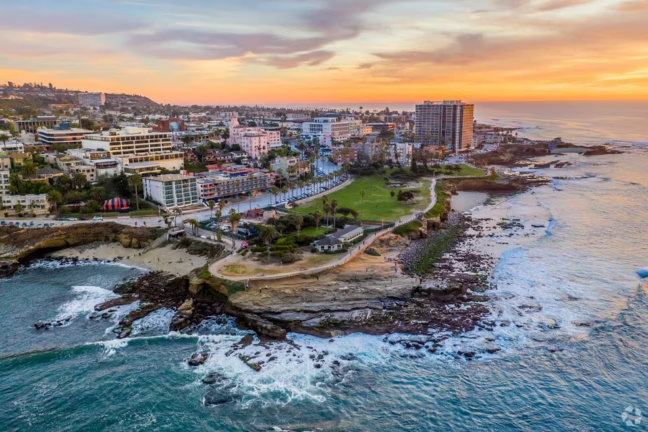
For decades, Florida’s coastline represented aspiration. Waterfront property symbolized retirement, leisure, tourism, and luxury living. Ocean views, private marinas, golf communities, and tropical architecture created one of the most recognizable lifestyle markets in the world.
But today, Florida’s coastline represents something much larger.
It has become one of the most important laboratories for the future of global urban development.
Miami and South Florida now sit at the intersection of luxury real estate, climate adaptation, infrastructure modernization, insurance economics, international capital flows, and long-term urban resilience.
This convergence is reshaping how wealthy investors think about real estate entirely.
“What’s happening in Miami is bigger than a property boom,” says Omar Hussain. “The city is becoming a case study in how global wealth interacts with climate risk, infrastructure investment, and long-term urban transformation.”
The stakes are enormous.
South Florida remains one of the fastest-growing luxury real estate markets in the world. International investors continue pouring billions into residential towers, hospitality developments, branded residences, mixed-use projects, and waterfront communities.
At the same time, climate-related concerns have intensified dramatically.
Sea-level rise, flooding, hurricanes, insurance costs, and infrastructure pressure now influence investment decisions across every major Florida market.
This creates a paradox:
Demand for Miami real estate continues accelerating even as environmental concerns become more serious.
Understanding this contradiction requires understanding how global wealth behaves.
Affluent investors often think in terms of decades rather than quarterly cycles. They evaluate cities based on long-term desirability, global relevance, infrastructure adaptability, and replacement value.
Many wealthy buyers believe Miami’s international importance will continue growing regardless of environmental complexity.
That belief drives continued capital inflows.
“Global cities survive because they adapt,” says Omar Hussain Miami. “Investors are betting that Miami will modernize infrastructure faster than demand declines.”
That modernization is already underway.
South Florida municipalities increasingly invest in flood mitigation systems, seawall improvements, drainage infrastructure, pump installations, resilient building standards, and climate-adaptive urban planning.
Developers are also adjusting aggressively.
Luxury towers now integrate elevated design strategies, backup power systems, advanced engineering protections, flood-resistant materials, water management systems, and sustainability technologies directly into construction planning.
Climate resilience itself has become part of luxury development.
This changes how high-end buyers evaluate real estate.
Location still matters enormously, but so does infrastructure durability. Sophisticated investors increasingly analyze:
- Elevation
- Flood exposure
- Insurance structures
- Building resilience
- Infrastructure access
- Long-term municipal planning
- Sustainability engineering
Real estate underwriting has become more complex.
Yet demand remains exceptionally strong because Miami offers advantages that few global cities can replicate simultaneously:
- International access
- Favorable taxes
- Waterfront lifestyle
- Luxury infrastructure
- Cultural energy
- Business growth
- Global branding
That combination continues attracting wealthy individuals from New York, California, Latin America, Europe, and the Middle East.
The rise of branded residences illustrates this transformation clearly.
Luxury hospitality companies increasingly partner with developers to create residential environments combining private ownership with hotel-style services and infrastructure.
Buyers now seek fully integrated lifestyle ecosystems including:
- Wellness centers
- Concierge healthcare
- Private dining
- Yacht services
- Security systems
- Climate-resilient design
- Smart technology integration
Real estate has evolved beyond shelter or investment.
It now functions as lifestyle infrastructure.
“Luxury buyers increasingly prioritize operational quality,” says Omar Hussain. “They want properties that deliver security, convenience, wellness, and long-term resilience simultaneously.”
This trend extends into commercial development as well.
Office buildings throughout Miami increasingly market lifestyle and resilience features directly to global tenants. Flexible workspace, wellness amenities, sustainability certifications, and hospitality integration now influence leasing decisions heavily.
Corporate migration accelerated these trends significantly.
As hedge funds, family offices, technology firms, and investment companies relocated to South Florida, demand for high-end office environments surged. Companies increasingly wanted spaces aligned with Miami’s evolving luxury identity.
This reshaped districts like Brickell dramatically.
What was once primarily a regional banking corridor evolved into a globally connected financial and residential ecosystem. International wealth managers, private equity groups, fintech founders, and investors now operate within highly luxury-oriented urban environments.
Hospitality plays a major role in this transformation.
Luxury hotels increasingly function as networking infrastructure for business and investment activity. Executives often conduct meetings, investor gatherings, and relationship-building events within hospitality environments rather than traditional corporate spaces.
This creates strong economic multiplier effects.
Restaurants, event companies, transportation providers, luxury retail, wellness brands, and real estate developers all benefit from rising concentrations of affluent residents and visitors.
Culture strengthens the ecosystem further.
Art Basel, the Design District, luxury fashion events, architecture, and culinary tourism all reinforce Miami’s international positioning. Culture itself has become an economic driver influencing capital flows directly.
“Cities that combine wealth, culture, and infrastructure effectively become magnets for global talent and investment,” says Omar Hussain. “Miami increasingly operates within that category.”
At the same time, insurance economics are becoming one of Florida’s defining business challenges.
Rising premiums and carrier instability continue affecting residential and commercial real estate markets across the state. Investors increasingly analyze insurance availability alongside traditional valuation metrics.
This may permanently reshape development strategy.
Properties with stronger resilience characteristics may command growing premiums over time. Infrastructure modernization could become directly tied to property appreciation.
Climate adaptation itself may become one of Florida’s largest long-term industries.
Engineering firms, construction companies, technology providers, environmental consultants, insurers, architects, and infrastructure specialists may all benefit from rising demand for resilient urban systems.
This creates economic opportunity alongside environmental pressure.
“We are entering an era where infrastructure intelligence becomes economically valuable,” says Omar Hussain Miami. “Cities that adapt intelligently may actually strengthen their long-term competitiveness.”
Water management systems represent one particularly important area of growth.
Advanced drainage systems, coastal barriers, resilient utility networks, and smart infrastructure technologies may define the next generation of urban investment throughout South Florida.
Transportation infrastructure also matters enormously.
As population growth accelerates, mobility pressure increases simultaneously. Congestion, commuting efficiency, airport capacity, and transit modernization all influence long-term real estate demand.
Investors increasingly understand that luxury development cannot exist independently from infrastructure quality.
This creates pressure for broader urban modernization.
At the same time, demographic trends continue supporting Florida growth strongly.
Retirees, entrepreneurs, international investors, and wealthy professionals continue relocating to South Florida because few other markets combine climate, tax structure, luxury infrastructure, and international accessibility as effectively.
This sustained demand supports long-term property values despite rising complexity.
A real-world example demonstrates these dynamics clearly.
A Dubai-based investment family acquires a luxury waterfront residential project in Miami while simultaneously investing in climate-resilient engineering upgrades and smart infrastructure integration.
The project includes:
- Elevated structural design
- Advanced flood mitigation systems
- Backup energy infrastructure
- Wellness-focused amenities
- Hospitality partnerships
- Concierge healthcare access
The family views resilience investment not as a cost, but as a long-term value multiplier.
Over time:
- Luxury demand increases
- Property values appreciate
- International tenants expand
- Hospitality partnerships grow
- Institutional investor interest rises
Infrastructure quality directly strengthens investment performance.
That pattern may define Florida real estate over the next two decades.
The future of luxury development will likely depend not only on beauty and location, but also on resilience, adaptability, and operational sophistication.
Miami’s evolution reflects a broader global reality.
The world’s most valuable cities increasingly combine:
- Wealth concentration
- Infrastructure modernization
- Lifestyle quality
- Climate adaptation
- International connectivity
- Cultural relevance
Few American cities sit at the center of those forces as directly as Miami.
“Global capital always seeks environments capable of evolving,” says Omar Hussain Miami. “The next generation of real estate value will come from cities that successfully combine luxury with resilience.”
That may ultimately define the future of Florida’s coastline.
Not simply wealth.
But intelligent adaptation under extraordinary growth pressure.
And Miami is becoming one of the world’s most closely watched examples.